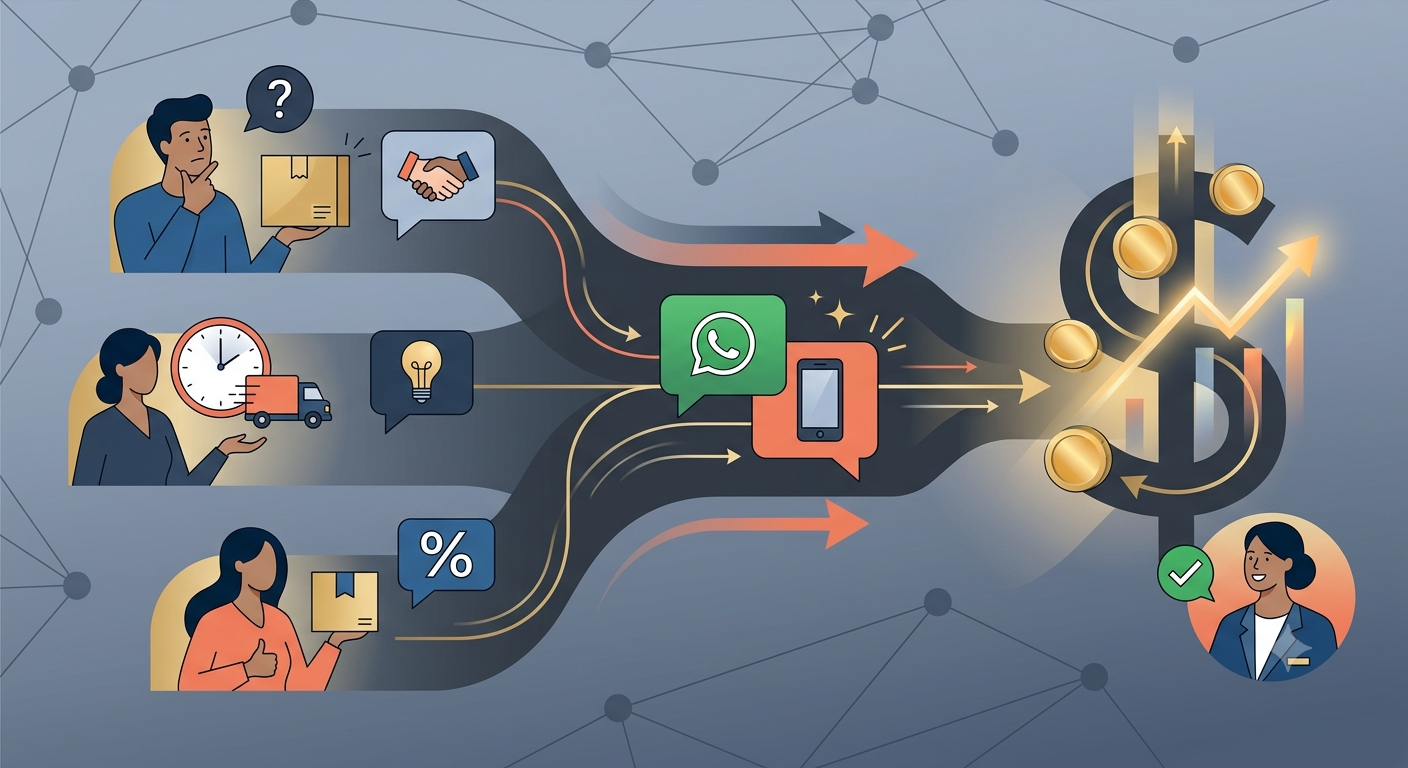
WhatsApp support operation is no longer limited to resolving complaints or answering customer questions. For ecommerce businesses, SaaS companies, financial institutions, logistics providers, healthcare organizations, and retailers, it has become a strategic channel for driving customer retention, increasing lifetime value, and generating additional revenue. Every support conversation contains valuable signals about customer intent, product interest, future purchases, and expansion opportunities. The challenge is not the lack of commercial potential. It is that most businesses have no structured system for identifying these opportunities without compromising the customer experience.
Many organizations continue to separate customer support and sales into completely independent functions. Support teams focus on resolving tickets, while sales teams pursue revenue with little visibility into existing customer conversations. As a result, buying signals are missed, valuable context is lost during handoffs, and customers receive fragmented experiences that reduce both trust and conversion rates.
Commercially intelligent customer support bridges this gap. Rather than encouraging agents to sell during every interaction, it creates a structured framework for recognizing qualified buying signals, preserving conversation context, routing opportunities to the appropriate commercial teams, and measuring the revenue generated from support interactions. The priority remains solving the customer’s problem first. Sales opportunities are introduced only when they naturally align with the customer’s needs and improve the overall experience.
This guide explains how to transform WhatsApp customer support into a measurable revenue channel using conversation classification, support-to-sales handoff workflows, attribution models, agent enablement, performance metrics, and operational best practices. By combining excellent customer service with structured commercial processes, businesses can increase revenue while strengthening customer relationships and delivering a more consistent support experience.
The Revenue Hidden Inside Your Support Queue
Before diving into the framework, let’s establish the size of the opportunity most teams managing a WhatsApp support operation are currently ignoring.”
Consider a mid-sized Nigerian business handling 400 WhatsApp support conversations per week. These conversations range from delivery inquiries to product questions to complaints. Most of them are handled efficiently and closed. The customer gets their answer, the agent moves on, and the business never thinks about that conversation again.
But hidden inside those 400 conversations is revenue that is walking out the door.
If even 15% of those conversations contain a commercial signal, an availability question, a post-purchase satisfaction moment, a complaint from a loyal customer, that is 60 revenue-moment conversations per week that currently go nowhere. Sixty opportunities per week to deepen a relationship, to recover a customer who is frustrated, to convert an inquiry into an order. Over a year, that is more than 3,000 conversations where the customer was telling the business they were ready to engage commercially, and the business did nothing.
This is passive revenue leakage, a moment that could have converted but didn’t because nobody designed what should happen next.
The distinction between passive revenue leakage and active revenue destruction is important. Active revenue destruction is when a commercial attempt damages the relationship. A support agent who tries to sell too early, before resolving the customer’s problem, actively destroys trust. Most teams fear this so much that they never address passive leakage. They choose safe silence over risky selling. The problem is that silence is not neutral. Silence is still a choice, the choice to leave revenue uncollected.
The core insight is this: the problem is not that support agents aren’t selling. The problem is that nobody has defined which conversations deserve a commercial moment and what that moment should look like. Support agents are not trained to recognize commercial signals. They do not have approved message templates for commercial closes. They do not know when to escalate and when to act. And without this definition, the default is silence.
The Three Support Conversation Types With The Highest Commercial Signal
Not every support thread is a revenue opportunity. But three types consistently are, and they are identifiable before a single message is sent. This taxonomy gives you your first actionable tool: a way to classify incoming conversations by their commercial potential before the agent even replies.
Type One: The Delay Complaint
A customer is frustrated about a late delivery or unfulfilled order. On the surface, this is a problem to resolve. Underneath it, this is a customer who is already emotionally invested in the brand. They ordered. They are waiting. They care enough to follow up. A customer who does not care simply asks for a refund or never orders again. A customer who follows up is still engaged.
The commercial opportunity in a delay complaint is not the discount itself. It is the recovery moment. A resolved delay complaint from a customer who then receives a small recovery offer, a discount, a priority slot, a loyalty credit, converts to a repeat purchase at a measurably higher rate than a cold outreach to a new contact. The customer who experienced a problem and had it resolved well is often more loyal than the customer who never had a problem at all.
The timing rule for delay complaints: the commercial offer belongs after resolution, never during. A customer who is still frustrated about a late order does not want a discount on their next purchase, they want the current one fixed. Introducing a commercial message before that resolution lands as tone-deaf and erodes the relationship. The sequence must be: resolve, confirm resolution, then offer. Never offer, then resolve.
Type Two: The Availability Question
“Do you have X in stock?” or “When will Y be available?” is the clearest buying signal a support thread can produce. The customer is not browsing, they are in an active purchase mindset, and the only thing standing between them and a transaction is information.
The commercial opportunity here is not an upsell. It is converting an inquiry that was going to die in a support thread into a confirmed order. The customer has already decided they want the product. They just need to know when they can get it. The support agent who handles this inquiry must be equipped to close it, to confirm availability, to offer a reservation, to guide the customer to checkout. If the agent simply answers “yes, we have it” and closes the thread, the customer may or may not complete the purchase. If the agent answers and then says “would you like me to reserve one for you?” the customer almost certainly will.
The routing rule for availability questions: these conversations should be escalated to a sales-capable agent, not handled by a support agent who lacks closing training. The support agent can answer the question. The sales agent can close the deal.
Type Three: The Post-Purchase Follow-Up
A customer messages to say thank you, to ask a usage question, or to share a problem they encountered after buying. This is the highest-trust conversation type in a support queue. A customer who took time to follow up after a purchase is telling you they are engaged. They are not a passive buyer. They are an active participant in the relationship.
The commercial moment here is a cross-sell, not a discount, not a promotion, but a natural, contextual suggestion that treats them as a known customer rather than a cold prospect. A customer who bought a skincare product and messages to ask about usage is signalling that they care about results. The commercial close is not “buy this other product.” It is “since you are using our cleanser, you might want to know about our toner, it works well with it.” The cross-sell is contextual, earned, and feels like helpful advice rather than a sales pitch.
The tagging rule for post-purchase follow-ups: these conversations should be tagged as “high commercial potential” and routed to an agent who is trained to recognize and act on cross-sell opportunities. The agent should also note the customer’s purchase history so that the cross-sell is genuinely relevant.
Support Conversation Classification Framework
Not every WhatsApp support conversation should trigger a commercial offer. The first step is to classify conversations based on their commercial potential. This framework helps support teams identify when a conversation should remain purely service-focused and when it presents a genuine opportunity for cross-selling, upselling, or escalation to the sales team. Each conversation type has different buying signals, timing considerations, and recommended actions.
Delay Complaints
Delay complaints occur when customers contact support because an order, delivery, service request, or promised update has not been completed within the expected timeframe. These conversations are primarily about restoring confidence and resolving frustration rather than making a sale.
Commercial Signal
Although customers in this category are often dissatisfied, they may still demonstrate strong purchase intent by expressing urgency, requesting faster alternatives, or asking about premium delivery, replacement options, or upgraded services. These signals indicate future revenue potential, but only after the original issue has been resolved.
Best Timing
Commercial recommendations should never be introduced before the customer’s concern has been fully addressed. Once the issue has been resolved and the customer’s confidence has been restored, support agents can recommend relevant premium services or future purchase options if they clearly improve the customer’s experience.
Recommended Offer
Examples include expedited delivery services, priority support plans, subscription upgrades, replacement products, or service packages that directly address the cause of the complaint.
Availability Questions
Availability questions come from customers asking whether a product, service, or feature is available, in stock, or suitable for their needs. These conversations often indicate active purchase intent because the customer is already evaluating a buying decision.
Commercial Signal
This conversation type carries one of the strongest buying signals in customer support. Customers are actively seeking information before making a purchase, making them highly qualified for commercial engagement.
Best Timing
Support agents can introduce product recommendations, alternative options, bundles, or purchasing guidance during the conversation because the customer has already demonstrated buying intent.
Recommended Offer
Relevant recommendations may include complementary products, premium plans, product bundles, subscription upgrades, or alternative products when the requested item is unavailable.
Post-Purchase Follow-ups
Post-purchase follow-ups occur after a customer has completed a purchase and contacts support for onboarding, setup assistance, usage guidance, warranty questions, or general after-sales support.
Commercial Signal
Customers who have recently completed a successful purchase often represent the highest opportunity for customer expansion. Positive engagement after a purchase frequently creates opportunities for cross-selling, upselling, renewals, referrals, and increased customer lifetime value.
Best Timing
Recommendations should only be introduced after the customer has successfully achieved their original objective and expresses satisfaction with the support experience. The recommendation should naturally extend the value of their existing purchase.
Recommended Offer
Suitable offers include complementary accessories, premium features, maintenance plans, training services, subscription upgrades, extended warranties, or products that enhance the customer’s original purchase.
| Support Conversation | Commercial Signal | Best Action | Offer Timing |
|---|---|---|---|
| Delay Complaint | Medium | Resolve then recover | After resolution |
| Availability Question | High | Guide to checkout | Immediately |
| Post-purchase Follow-up | High | Contextual cross-sell | After answering |
Designing The Support-to-Sales Handoff
The mechanics of moving a commercial-signal conversation from a support agent to a sales-capable agent without losing context or damaging the customer experience are critical to this framework working. A poorly executed handoff kills the commercial moment entirely. A clean handoff preserves trust and sets up the close.
Start with the failure mode. A customer messages a support agent about a product they want to buy. The support agent answers their questions but cannot close the deal because they are not trained in sales. The agent transfers the conversation to a sales rep. The customer then has to explain their situation again. The sales rep asks questions that were already answered. The customer feels unheard, irritated, and less inclined to buy.
This is not just annoying. It is a trust signal that the business does not have its act together. The customer’s confidence erodes. The commercial moment evaporates. The business loses the sale not because the product was wrong or the price was too high but because the handoff was handled poorly.
A clean handoff requires three things.
Full conversation history visible to the receiving agent: The sales rep should not have to ask the customer to repeat anything. Every message exchanged with the support agent should be visible in the conversation thread before the sales rep types their first word. This is a technical requirement. If your system does not preserve conversation history across transfers, you cannot execute a clean handoff.
A context note that summarises the customer’s situation and the commercial opportunity in plain language: The support agent should leave a brief internal note: “Customer is interested in product X. Asked about delivery timeline and warranty. Has budget approved. Ready to buy if we can confirm availability.” This note tells the sales rep exactly what they need to know without reading the entire thread.
A warm transition message that does not make the customer feel passed around: The support agent should introduce the sales rep in a way that feels like an upgrade, not a transfer: “I have answered your questions about the product. I would like to introduce Tunde from our sales team, he can help you with the next steps. I have shared everything we discussed with him so you don’t have to repeat yourself.” The customer feels they are gaining access to expertise, not being handed off to a different department.
Routing rule design
A clean handoff also requires clear rules about when a commercial escalation should happen. The rule set is simple.
Trigger: A conversation type tag that indicates commercial potential, availability question, delay complaint with positive resolution, or post-purchase follow-up, combined with a resolution confirmed status and a customer sentiment that is neutral or positive. If the sentiment is negative, the escalation is off.
Destination: The conversation should be routed to a sales-capable agent pool, not a generic queue. The receiving agent should have demonstrated competence in commercial conversations and have access to the customer’s purchase history and conversation history.
Timing: Commercial escalation should happen inside the same session, not 24 hours later when the moment has evaporated. If the support agent resolves the issue at 2pm, the commercial escalation should happen at 2:05pm, not the following morning. The customer’s engagement is highest immediately after their problem is resolved. Waiting loses the window.
When Should You Sell During a WhatsApp Support Conversation?
This section earns the reader’s trust by being honest about where the framework breaks down. Not every support conversation is a revenue opportunity. Some conversations should end with a clean resolution and nothing more. Pushing a commercial moment into these conversations does not generate revenue. It destroys trust.
Name the two conditions under which a commercial moment inside a support thread will always backfire.
Condition One: The underlying support issue has not been fully resolved. A customer who is still waiting for a refund, still tracking a missing order, or still dealing with a defective product does not want to hear about what else they can buy. They want the current problem fixed. Introducing a commercial message before that resolution is achieved is not just ineffective. It signals that the business cares more about selling than about solving. The customer feels used.
Condition Two: The customer’s emotional state is still negative. A customer who is frustrated, angry, or anxious about a problem is not ready to receive a commercial offer. Even if the issue is technically resolved, the emotional residue remains. The customer needs to feel that the business has genuinely addressed their concern before they are open to further engagement. Pushing a commercial offer too soon reads as dismissive.
The solution is a sentiment detection layer. This can be implemented through agent judgement, a trained support agent can read the tone of a conversation and assess whether the customer is genuinely satisfied, or through automated sentiment tagging. The key is that the commercial logic should not activate until the sentiment is confirmed as neutral or positive. A customer who has just resolved a complaint and is genuinely grateful is ready. A customer who has just resolved a complaint and is still upset is not.
Make the case for restraint as a commercial strategy. A support team that resolves issues cleanly and then says nothing commercial builds more repeat purchase behaviour than one that pushes offers into every resolved thread. The customer who has a problem, has it resolved well, and feels no pressure to buy again often comes back anyway, because the resolution itself created trust. The customer who has a problem, has it resolved, and is immediately offered a discount may feel that the resolution was merely a prelude to a sales pitch. The trust is not deepened. It is slightly eroded.
The framework is not about maximising commercial touches. It is about making the right commercial touch in the right conversation at the right moment.
Give a clear decision rule: If the support issue consumed more than two exchanges to resolve, or if the customer used any language indicating frustration, “annoyed,” “disappointed,” “not happy,” “this is unacceptable”, the commercial moment in that conversation is off. Follow up 48 hours later through a separate automation, not in the thread. The automation can check in on the customer’s satisfaction and, if the response is positive, introduce a commercial offer then. This separates the resolution from the sales attempt and preserves trust.
Should This Support Conversation Include A Sales Offer?
Issue resolved?
↓
No
↓
Do not sell.
↓
Yes
↓
Customer sentiment positive?
↓
No
↓
Wait 48 hours.
↓
Yes
↓
Commercial signal detected?
↓
No
↓
Close conversation.
↓
Yes
↓
Recommend product.
How To Upsell And Cross-Sell During WhatsApp Support Conversations
The message itself is where the framework succeeds or fails. Tone, timing, and offer design are the three variables that determine whether a commercial message inside a support thread feels natural or predatory. Get any of them wrong, and the trust built during resolution is undone.
Tone
Commercial messages in support threads should read like they are from someone who knows the customer, not from a promotions department. First person language. Reference to the specific interaction. No exclamation marks. No urgency language. No “limited time” or “act now.” The customer is not in a promotional mindset. They are in a relationship mindset. The message must match.
Effective tone: “Since you’ve been ordering our skincare line, thought you might want to know we just restocked the toner you asked about last month.”
Ineffective tone: “Great news! We have a special offer just for you! Don’t miss out!”
The first reads like a conversation. The second reads like a broadcast. The first preserves trust. The second erodes it.
Timing
The offer should land at the end of the resolution, not mid-thread. A specific recommended structure: resolution message → one-line transition → commercial suggestion → zero pressure close.
The resolution message confirms the customer’s problem is solved: “Your order has been confirmed and will be delivered tomorrow by 2pm.”
The one-line transition acknowledges the relationship: “Since you’re already a customer, I wanted to mention something.”
The commercial suggestion is specific and contextual: “We just got a new shipment of the matching trousers for the shirt you ordered. They’re selling quickly, so I thought you might want to know.”
The zero pressure close leaves the customer in control: “No pressure at all — just thought you’d want to be aware.”
The entire commercial section should be no more than two messages. Any longer and it becomes a sales pitch. Two messages is a suggestion.
Offer Design
The offer must be contextually earned. A customer who complained about a delay earns a recovery offer, a discount, a priority slot, a loyalty credit. A customer who asked about availability earns an early access or reservation offer. A customer who followed up post-purchase earns a loyalty-adjacent cross-sell. Generic promotions sent to every resolved thread are not support-to-revenue conversion. They are just broadcast with extra steps.
The offer type must match the conversation type.
For a delay complaint, the offer is a recovery incentive. The message structure: resolve the delay, confirm the resolution, then offer a small incentive as a gesture of goodwill: “To make up for the inconvenience, here’s a 10% discount on your next order. No pressure to use it, just wanted to say thank you for your patience.”
For an availability question, the offer is a reservation or guided checkout. The message structure: confirm availability, then offer to hold the item: “We have it in stock. Would you like me to reserve one for you while you complete your order?”
For a post-purchase follow-up, the offer is a contextual cross-sell. The message structure: answer the inquiry, then suggest a complementary product: “Since you are using our cleanser, you might want to know about our toner, it works well with it. Happy to send you more info if you’re interested.”
Attribution Logic: Crediting Revenue That Originates in a Support Thread
The operational problem that keeps this entire framework invisible in most businesses is attribution. If a customer buys three days after a support conversation, nobody knows the support conversation caused it. The revenue gets credited to a marketing campaign, a Google search, or “direct traffic.” The support operation that generated the sale gets no credit. The framework looks like it is not working because the results are invisible.
Attribution is not an accounting exercise. It is a management tool. If you cannot see the revenue your support operation is generating, you cannot make the case for investing in support infrastructure, training, or the systems that enable this framework. You cannot prove that the framework works. You cannot improve what you cannot measure.
Define The Attribution Window
For support-originated revenue, a 72-hour window is the practical standard. Any purchase made by the same contact within 72 hours of a resolved support conversation that included a commercial touch should be credited to that conversation.
The 72-hour window is long enough to capture customers who think about the offer and decide later. It is short enough to be credibly causal. A customer who buys three weeks after a support conversation was probably influenced by other factors. A customer who buys within three days was likely influenced by the conversation.
The Technical Requirement
The contact record needs a flag at the moment the commercial escalation happens. A tag, a pipeline entry, or a CRM event that records: “commercial moment attempted in support thread on [date] with [offer type].” This flag is the join key.
When the subsequent purchase is recorded, the system checks whether the contact has a commercial flag from a support conversation within the last 72 hours. If yes, the revenue is attributed to that conversation. Without that flag, the revenue is invisible to analysis. You cannot measure what you did not capture.
The flag is not complicated. It is a simple field on the contact record that is set when the commercial message is sent. It does not require complex analytics. It requires discipline, the discipline to set the flag every time a commercial moment occurs.
The Downstream Benefit
Once support-originated revenue is visible, it changes how support is staffed, trained, and measured. A support operation that generates measurable revenue is not a cost centre. It is a revenue centre. The business case for investing in support infrastructure changes from “we need to save money on support” to “we need to invest in support to generate more revenue.”
It also changes how support agents are evaluated. An agent who handles 100 conversations and generates 10 commercial closes is more valuable than an agent who handles 100 conversations and generates zero. This visibility enables performance differentiation, coaching, and compensation alignment.
Agent Training For Dual-Role Conversations
The human layer that every operational framework eventually depends on is the agent. The best routing logic, tagging architecture, and attribution infrastructure are useless if the agent on the other end of the conversation does not know what to do. Training is not an afterthought. It is the execution layer.
Start With The Reframe
The goal is not to turn support agents into salespeople. The goal is to make support agents commercially aware — able to recognise a revenue signal, tag it correctly, and either act on it or escalate it, depending on their role and the conversation type.
A support agent who can identify an availability question and escalate it to a sales agent is commercially aware. A support agent who can resolve a delay complaint and offer a recovery discount using an approved template is commercially aware. A support agent who can answer a post-purchase follow-up and suggest a complementary product is commercially aware.
The agent is not being asked to become a closer. They are being asked to recognise commercial moments and handle them according to a clear framework. The framework does the heavy lifting. The agent executes it.
The Three Things Agents Need To Know
Training must cover three specific areas.
Which conversation types warrant a commercial response. Agents need to recognise the three types described in Part Two: delay complaints, availability questions, and post-purchase follow-ups. They need to know the keywords, the customer signals, and the commercial potential of each type.
What the approved message structure looks like for each type. Agents need to know the exact message format for each conversation type. The resolution, the transition, the commercial suggestion, and the zero-pressure close. The templates are pre-approved. The agent does not have to write the commercial message from scratch. They just need to personalise it with the customer’s specific context.
When to escalate instead of acting themselves. An agent who is not comfortable with the commercial close should know when to escalate. The rule is simple: if the conversation is an availability question with high budget potential, escalate to sales. If the conversation is a delay complaint, handle the resolution and then escalate or act on the recovery offer depending on the agent’s training. If the agent is uncertain, escalate.
Addressing Resistance
Support teams often resist commercial moments. The fear of seeming pushy is real. The discomfort of switching register mid-conversation is genuine. The response to this is structural.
If the framework is designed correctly, agents are not making a judgement call about whether to sell. They are following a clear decision rule about when a conversation qualifies for a commercial close, and the close itself follows a template. The agent’s judgement is minimised. Their discomfort follows. The commercial moment becomes a procedural step, not a personal sales act.
A support agent who resolves a delay complaint and then sends the recovery offer from an approved template is not “selling.” They are following the process. The framework removes the emotional weight from the commercial moment.
Practical Onboarding Sequence
The training should follow a structured sequence.
Conversation type classification exercise: Agents practice identifying the three commercial conversation types from sample threads. They learn the keywords, the customer signals, and the commercial potential.
Message template practice with sample threads: Agents practice using the approved message templates in simulated conversations. They learn the resolution, the transition, the commercial suggestion, and the zero-pressure close.
Live review of the first 20 dual-role conversations: Before operating independently, each agent’s first 20 commercial-support conversations are reviewed by a supervisor. The review checks whether the agent identified the conversation type correctly, applied the right message template, and handled the commercial moment appropriately. The review is coaching, not criticism.
This sequence takes about one week to complete. The investment is small. The payoff is measurable.
KPIs For Measuring WhatsApp Support Revenue
A function that cannot be measured cannot be managed or improved. This section defines the four metrics that matter for support-to-revenue performance. These metrics are not complex. They are operational, actionable, and directly tied to business outcomes.
Metric One: Revenue Per Conversation
Total revenue attributed to support-originated commercial closes divided by total support conversations in the period. This is the baseline metric. It proves the function exists and is growing.
A business handling 400 support conversations per week that generates ₦200,000 in attributed revenue has a revenue per conversation of ₦500. Next week, if revenue per conversation rises to ₦600, the support operation is becoming more commercially effective. If it falls, something is wrong.
Revenue per conversation is the metric that answers the question: is our support operation generating more or less value per interaction? It is the north star for support-to-revenue performance.
Metric Two: Commercial Escalation Rate
The percentage of support conversations that were tagged as commercial-signal and routed for a commercial close. This measures whether agents are correctly identifying opportunities.
If the commercial escalation rate is 5% and the estimated commercial signal in the conversation volume is 15%, agents are missing two-thirds of the opportunities. The training is not sticking. The classification system is not being used. The framework is not being executed.
If the commercial escalation rate is 20% and the estimated commercial signal is 15%, agents are overcalling. They are tagging conversations that do not actually contain commercial potential. This is less damaging than undercalling, but it still indicates training gaps.
The target is alignment: commercial escalation rate matches the actual commercial signal rate within a reasonable margin.
Metric Three: Offer Acceptance Rate By Conversation Type
Of the commercial closes attempted, what percentage converted, broken down by delay complaint, availability question, and post-purchase follow-up. This reveals which conversation type is the highest-value commercial moment for a specific business.
Some businesses will find that availability questions convert at 25% while delay complaints convert at 8%. Others will find the opposite. The metric tells you where to focus training, where to refine the offer structure, and which conversation types deserve more attention.
If one conversation type has a consistently low acceptance rate, the offer design or message structure needs adjustment. If one has a consistently high rate, it deserves more attention in training and more resources in routing.
Metric Four: Trust Degradation Indicator
CSAT score for conversations where a commercial close was attempted versus conversations where it was not. If the scores diverge significantly, the commercial framework is being applied incorrectly, too early, too often, or in the wrong conversation types.
A 4.5 CSAT for non-commercial conversations and a 4.3 CSAT for commercial conversations is healthy. The commercial moments are not damaging trust. A 4.5 CSAT for non-commercial and a 3.8 CSAT for commercial is a problem. Customers are feeling pressured or sold to in ways that reduce their satisfaction. The framework needs adjustment.
The CSAT question should be simple: “How satisfied were you with your experience today?” The comparison between commercial and non-commercial conversations reveals whether the framework is preserving trust.
The Operational Cadence
These four metrics should be reviewed weekly by whoever owns both support and revenue outcomes. If those two functions report to different people, this review is the forcing function that gets them in the same room.
The weekly review answers three questions. Are we improving revenue per conversation? Are agents correctly identifying commercial opportunities? Are we maintaining trust while generating revenue? If the answer to any of these is no, the review identifies what needs to change.
Can customer support increase sales on WhatsApp?
Yes. Customer support can increase sales on WhatsApp by identifying genuine buying signals during customer conversations and introducing relevant recommendations after resolving the customer’s issue. Instead of treating support and sales as separate functions, businesses can use structured support-to-sales workflows to route qualified opportunities to the appropriate team. When implemented correctly, this approach increases customer lifetime value, improves retention, and generates additional revenue without compromising the customer experience.
How do you turn WhatsApp support into a revenue channel?
Turning WhatsApp support into a revenue channel requires a structured process rather than aggressive selling. Businesses should classify support conversations based on their commercial potential, train agents to recognize buying intent, create clear support-to-sales handoff procedures, preserve conversation history, and measure revenue generated from support interactions. By resolving customer issues first and recommending relevant products or services only when appropriate, organizations can generate additional revenue while maintaining high customer satisfaction.
When should support agents recommend products?
Support agents should recommend products only after the customer’s primary issue has been successfully resolved and there is a clear indication that the recommendation adds value. Customers asking about product availability, requesting additional features, or expressing future needs often present strong commercial signals. Recommendations should always be contextual, personalized, and directly related to the customer’s goals. Introducing sales offers too early or without relevance can reduce trust and negatively affect the support experience.
What is a support-to-sales handoff?
A support-to-sales handoff is the structured transfer of a customer conversation from a support agent to a sales representative after a qualified sales opportunity has been identified. An effective handoff includes the complete conversation history, customer context, buying signals, and any commitments already made during the support interaction. Preserving this information prevents customers from repeating themselves, maintains continuity, and enables sales teams to continue the conversation with full context.
How do you measure revenue generated from customer support?
Revenue generated from customer support is measured by tracking how support interactions contribute to completed sales. Key metrics include support-to-sales conversion rate, revenue attributed to support conversations, upsell and cross-sell revenue, average order value after support interactions, customer lifetime value, and successful handoff rates. Combining these commercial metrics with customer satisfaction (CSAT) and resolution metrics ensures businesses grow revenue without sacrificing service quality.
Should every support conversation include a sales offer?
No. The purpose of customer support is to resolve customer issues, not to sell during every interaction. Commercial recommendations should only be made when they are relevant to the customer’s needs and genuinely improve the customer’s outcome. Businesses that prioritize problem resolution before introducing contextual offers are more likely to preserve customer trust, increase long-term loyalty, and achieve higher conversion rates than those that treat every support conversation as a sales opportunity.
Example Of A Revenue-Generating WhatsApp Support Conversation
Return to the opening scenario. The fashion brand customer who messaged at 2pm on a Tuesday asking why their order hadn’t arrived. Walk it through the framework.
The customer messages: “My order #12345 was supposed to arrive yesterday. Where is it?”
The support agent checks the system. The delivery was delayed due to a logistics issue. The agent responds: “I apologize for the delay. Your order is now confirmed for delivery tomorrow by 2pm. I have also added a ₦1,000 credit to your account for the inconvenience.”
The customer responds: “Thank you, I appreciate that.”
The agent, seeing the conversation type tagged as delay complaint and the customer’s sentiment now positive, sends the recovery offer using the approved template: “Since you’ve been shopping with us, I wanted to mention that we just restocked the matching accessory for the item you ordered. No pressure at all, just thought you might want to know.”
The customer responds: “Oh, I didn’t know that was available. Can you add it to my order?”
The agent confirms the addition. The customer feels taken care of. The support operation generated revenue. The customer’s trust was deepened, not eroded. And nothing about the interaction felt like a sales call.
This is what commercially intelligent support looks like. It is not aggressive. It is not pushy. It is simply aware. It recognises that a customer who has just had a problem resolved is a customer who is engaged, grateful, and open to further conversation. It acts on that awareness in a way that feels natural and earned.
The businesses that will win on WhatsApp in the next three years are not the ones with the largest broadcast lists or the most aggressive sales scripts. They are the ones that have made every customer conversation, including the complaints, commercially intelligent. They are the ones that have built the infrastructure to recognize revenue signals in support conversations, route them to the right person, and close them without destroying trust.
Siteti provides the infrastructure that makes this kind of conversation-level logic operationally possible. Routing, tagging, attribution, automation, the technical layer that turns a support queue into a revenue channel. The framework described in this article is not theoretical. It is implementable. And the businesses that implement it first will have a competitive advantage that cannot be replicated by better products or lower prices.
The conversation you are already having with your customers is the conversation that will define your growth. Make it commercially intelligent.