For the past decade, the global CRM industry has been dominated by a single assumption: that customer relationships are best managed through email workflows, contact scoring, and pipeline stages tracked inside a centralized dashboard. HubSpot, as the most prominent exponent of this model, has built a billion-dollar business on that assumption.
It is an assumption that does not hold in Nigeria.
Nigerian small and medium enterprises (SMEs) operate in a fundamentally different communication environment. Over 90% of customer interactions occur on WhatsApp, not email. Response expectations are measured in minutes, not days. The customer journey, from first inquiry to payment confirmation, rarely touches an inbox. Yet thousands of Nigerian businesses continue to subscribe to dollar-denominated CRM platforms designed for markets where email open rates exceed 50% and where customers reliably engage with automated sequences.
The result is a persistent and expensive operational mismatch: Nigerian companies paying for enterprise-grade email automation while their sales teams manually manage conversations on personal phones.
This essay examines that mismatch in detail. It argues that HubSpot, while an excellent product for its intended market, is overkill for the majority of Nigerian businesses. It documents the real cost of dollar-based CRM subscriptions in the Nigerian context, identifies the structural reasons why WhatsApp has become the de facto customer communication channel in the country, and presents the case for a new category of CRM tools built around chat rather than email. Finally, it provides a practical framework for Nigerian businesses to evaluate whether switching to a WhatsApp-first, Naira-billed CRM is a strategic necessity rather than merely a cost-saving measure.
This analysis is intended for founders, operations leaders, and finance professionals at Nigerian SMEs who are currently subscribed to global CRM platforms but whose actual sales operations run on WhatsApp.
How Nigerian Businesses Actually Communicate With Customers
Any serious evaluation of CRM infrastructure must begin not with software features but with customer behavior. A CRM is, at its core, a mirror of how a business and its customers interact. When that mirror reflects the wrong communication channels, the entire system becomes decorative rather than functional.
In Nigeria, the communication channel that dominates customer-business interaction is WhatsApp.
The Communication Reality Of A Nigerian SME
A typical Nigerian SME does not begin its customer relationship with an email capture form. It begins with a phone number displayed on Instagram, a WhatsApp link shared on a business card, or a recommendation forwarded from an existing customer. The first interaction is almost always a chat message.
Consider the operational reality of a mid-sized Lagos-based fashion retailer. On any given day:
- Inquiries arrive via WhatsApp voice notes and text messages from 7 am onward
- Customers share screenshots of bank transfers as payment confirmation
- Logistics providers communicate delivery updates exclusively through WhatsApp
- Post-purchase complaints, returns coordination, and reorder requests all happen within the same chat threads
None of these interactions requires or even benefits from email. Yet a significant portion of Nigerian businesses using HubSpot attempt to map these WhatsApp-native workflows into email-based contact records and deal pipelines. The friction this creates is not merely inconvenient; it is commercially costly.
Why Email-First Assumptions Collapse In The Nigerian Context
HubSpot’s architecture assumes three conditions that do not reliably exist in the Nigerian market:
First, high email open rates. In mature email markets, open rates of 20–30% are considered standard. In Nigeria, business-to-customer email open rates typically fall below 10%, owing to spam filtering, multiple email addresses per user, and low cultural prioritization of email as a communication tool.
Second, customer willingness to complete web forms. HubSpot’s lead generation model depends on customers submitting information through landing pages and forms. Nigerian customers, by contrast, prefer to send a chat message with their name and inquiry in free text, a format that traditional CRMs cannot parse without manual data entry.
Third, the sales team’s compliance with dashboard logging. HubSpot assumes that sales representatives will log every customer interaction into the CRM. In practice, Nigerian sales teams, who manage dozens of simultaneous WhatsApp conversations on mobile devices, rarely interrupt their workflow to open a separate dashboard and update a contact record.
The result is a CRM system that contains incomplete data, requires constant manual correction, and ultimately fails to provide the visibility it promised.
Quantifying WhatsApp Dominance In Nigeria
The preference for WhatsApp is not anecdotal. As of 2025, WhatsApp penetration among Nigerian smartphone users exceeds 90%, with daily active usage averaging over three hours per user. For context, email usage among the same demographic averages less than 30 minutes per day, and a significant portion of that is personal rather than commercial communication.
More importantly, customer expectations have hardened around WhatsApp. A business that responds to an email inquiry within 24 hours is considered professional. A business that takes 24 hours to respond to a WhatsApp message is considered unresponsive. The channel dictates the response standard, not the business.
Case Example: A Port Harcourt Logistics Company
A mid-sized logistics company in Port Harcourt implemented HubSpot in early 2025 following a recommendation from an industry peer. The implementation included email sequences for customers onboarding, automated reminders for pending deliveries, and a pipeline to track leads from inquiry to payment.
Within three weeks, the company abandoned the email sequences entirely. Customer response rates to email onboarding messages were under 5%. Drivers refused to check their email for delivery updates. Customers continued to send payment confirmations via WhatsApp screenshots, which had no automated connection to the HubSpot deal pipeline.
The company reverted to a manual WhatsApp-based system, not because it was ideal, but because it was the only system that matched how their customers actually behaved. They continued paying for HubSpot for another four months before canceling.
What “WhatsApp-First” Means Operationally
A WhatsApp-first CRM is not merely a CRM with a WhatsApp integration added as a feature. It is a fundamentally different operational model in which:
- The conversation thread is the primary record, not the contact profile
- Customer history, purchase context, and communication logs are captured automatically through chat, not manually entered
- Response time tracking, agent workload visibility, and broadcast management are built around WhatsApp’s interface rather than retrofitted onto it
For a Nigerian business, adopting a WhatsApp-first CRM means aligning infrastructure with reality. It means recognizing that the customer journey, from the first “Is this available?” to the final “Thank you, I have received it”, already happens inside WhatsApp. The only question is whether the business has the tools to manage that journey at scale.
What HubSpot Was Built For And Why That Matters
To understand why HubSpot is overkill for most Nigerian businesses, one must first understand what HubSpot was designed to do. The gap between HubSpot’s intended use case and the operational reality of Nigerian SMEs is the single most important factor in evaluating its relevance.
HubSpot’s Origin And Target Market
HubSpot was founded in 2006 with a clear thesis: traditional outbound marketing (cold calls, billboards, broadcast advertising) was losing effectiveness, and the future belonged to inbound marketing, attracting customers through useful content, email nurturing, and website conversion funnels.
This thesis was tailored to a specific market: United States and European B2B companies with sales cycles measured in weeks or months, decision-makers who check email multiple times daily, and marketing budgets that could support content production and paid advertising.
HubSpot’s early adopters were software companies, marketing agencies, and professional services firms. Their customers were other businesses. Their primary communication channel was email. Their sales process involved multiple touches over an extended period. In this context, HubSpot’s feature set was not merely useful; it was transformative.
The Features HubSpot Charges For
HubSpot’s pricing is structured around a core set of capabilities. Understanding what these features cost reveals what HubSpot believes is valuable.
Email marketing sequences: The ability to send automated emails triggered by customer behaviour, a form submission, a link click, or a period of inactivity. This is HubSpot’s signature capability and the primary reason businesses upgrade from free to paid tiers.
Contact scoring: A system that assigns numerical values to leads based on their engagement with emails, website visits, and form submissions. The logic is that more engaged leads are more likely to convert.
Website analytics integration: The ability to track individual contacts as they navigate a business’s website, seeing which pages they viewed and how much time they spent on each.
Meeting scheduling: Automated calendar links that allow prospects to book time with sales representatives without back-and-forth emails.
Sales pipeline management: Visual deal stages that move from “New Lead” to “Contacted” to “Proposal Sent” to “Closed Won” or “Closed Lost”.
Each of these features solves a genuine problem. Each also assumes a specific set of conditions about how businesses and customers interact.
While These Features Solve Real Problems, Just Not Nigeria’s Problems
Consider email sequences. For a B2B software company selling to US marketing directors, an automated email sequence that delivers case studies, product comparisons, and pricing information over ten days is a proven conversion tool. The recipient expects these emails, opens them on a laptop during work hours, and clicks through to the website.
For a Nigerian fashion retailer selling to individual customers, the same sequence lands in a spam folder or is deleted without being opened. The customer does not expect business communication via email. The retailer has wasted time building automation that reaches no one.
Consider contact scoring. For a B2B services firm, scoring leads based on email opens and website visits distinguishes hot prospects from cold ones. For a Nigerian SME, the score is meaningless because the underlying data, email engagement, does not exist for most customers.
Consider website analytics integration. This assumes that customers discover the business through its website and that tracking their on-site behavior provides useful sales intelligence. In Nigeria, most customers discover businesses through social media or referrals, and their first interaction is a WhatsApp message, not usually a website visit.
None of this is HubSpot’s failure. HubSpot built what its primary market asked for. The failure lies in assuming that a product optimised for Boston and London would work equally well in Lagos and Abuja without fundamental adaptation. The question is not whether HubSpot is good software. It is. The question is whether it is the right software for Nigerian businesses operating in a WhatsApp-first, Naira-budget environment. That question, as the subsequent sections will demonstrate, answers itself.
The Real Cost Of HubSpot For A Nigerian Business in 2026
The advertised price of any SaaS product is rarely the price a business actually pays. For Nigerian businesses subscribing to dollar-denominated platforms, the gap between list price and real cost is substantial and frequently unacknowledged in purchasing decisions.
This section breaks down the complete cost of HubSpot for a Nigerian business in 2026, including subscription fees, hidden expenses, and the compounding effect of exchange rate volatility. It then presents a direct cost and feature comparison with Siteti, a WhatsApp-first CRM built for the Nigerian market with transparent Naira billing.
The Subscription Cost in Naira
HubSpot offers three primary tiers for its Sales Hub product, each with distinct feature sets and pricing.
Starter tier: Listed at $20 per seat per month when billed annually. At a conservative exchange rate of ₦1,500 per dollar, this translates to approximately ₦30,000 per user monthly. For a five-person sales team, the annual commitment exceeds ₦1.8 million before any additional fees.
Professional tier: Listed at $800 per month for three seats when billed annually. The Naira equivalent at current rates is approximately ₦1.2 million monthly, or ₦14.4 million annually. This is the tier where genuinely useful features, deal pipelines, reporting dashboards, and automation become available.
Enterprise tier: Listed at $3,600 per month for five seats. The Naira equivalent exceeds ₦5.4 million monthly. This tier is not designed for SMEs by any reasonable definition.
The critical observation is not merely the absolute cost but the feature distribution. The Starter tier lacks the automation and reporting capabilities that would justify switching from a manual WhatsApp system. The Professional tier provides those capabilities but at a price point that exceeds the monthly operating budget of most Nigerian SMEs.
The Hidden Costs Nigerian Businesses Do Not Account For
The subscription fee is the visible cost. Four additional categories of expense routinely go unaccounted for.
Implementation cost: HubSpot is not a plug-and-play system. Proper implementation requires data migration from existing spreadsheets or CRMs, workflow configuration for deal stages and automation rules, and integration setup with any other tools the business uses. Nigerian businesses typically require either a dedicated internal resource for two to four weeks or an external agency charging between ₦500,000 and ₦2 million for proper setup.
Training cost: Getting a sales team to consistently log WhatsApp conversations into a separate CRM dashboard is not a technical problem; it is a behavior change problem. Effective training requires initial sessions, ongoing reinforcement, and regular auditing. For a team of five sales representatives, the time cost alone typically exceeds 40 person-hours per month in the first quarter.
Integration cost: HubSpot does not natively connect to WhatsApp Business API. To manage WhatsApp conversations within HubSpot, a business must subscribe to a third-party middleware solution such as TimelinesAI or WATI. These tools add another $30 to $100 per month in dollar-denominated fees, plus implementation and maintenance overhead.
Opportunity cost: The weeks spent implementing, training, and troubleshooting a complex CRM system are weeks during which sales activity is disrupted. Leads go unresponded to. Follow-ups are missed. The cost of this disruption is difficult to quantify, but for a business with tight margins, it frequently exceeds the direct subscription cost.
The FX Tax
Perhaps the most underappreciated cost of HubSpot for Nigerian businesses is exchange rate volatility. A subscription priced in dollars creates a variable expense in Naira terms even when the dollar price remains fixed. A business that subscribed to HubSpot Professional in January 2024 at an exchange rate of ₦900 per dollar paid approximately ₦720,000 monthly. By January 2026, with the exchange rate at ₦1,500 per dollar, the same subscription costs ₦1.2 million monthly, a 67 percent increase for identical software.
No Nigerian business budgets for a 67 percent cost increase over 24 months with no change in service received. Yet this is precisely the financial reality of dollar-denominated SaaS subscriptions.
Beyond the direct exchange rate impact, Nigerian businesses face additional FX-related costs:
- International transaction fees of 2–5 percent on dollar payments
- Virtual dollar card maintenance fees for businesses without direct dollar accounts
- Bank processing delays that can result in subscription interruptions and reactivation fees
The Siteti Alternative: Transparent Naira Pricing and WhatsApp-Native Features
In contrast to HubSpot’s dollar-denominated cost structure, Siteti offers fixed Naira pricing with no FX exposure. As an official Meta Solutions Partner, Siteti provides the official WhatsApp Business API with local support and billing.
Siteti Pricing Plans (as of 2026):
| Plan | Monthly Price (₦) | Key Features |
| Starter | ₦46,400 | Shared Team Inbox for 5 users, Bulk WhatsApp Broadcast, Scheduled, Inbound Calls Broadcasts, Quick Replies, Automation via Chatbot Builder, |
| Growth | ₦94,400 | Everything in Starter plus, Shared Team Inbox for 20 users, Custom Broadcasts via public API, Broadcast Message Analytics, Catalog, Webhook Support, WhatsApp Flows, and Call Recording |
| Pro | ₦638,400 | Everything in Growth plus Shared Team Inbox (Unlimited Users), Custom Integrations, Priority Support |
Key differentiators of Siteti:
Payment in Naira: Siteti accepts payments via Paystack, Flutterwave, or any Nigerian debit card. No dollar card is required. Businesses can also choose to view pricing in USD if preferred, but Naira billing eliminates exchange rate risk.
Official WhatsApp Business API: Unlike browser extensions or unofficial tools that risk permanent number bans, Siteti connects directly to Meta’s official API, ensuring compliance and account safety.
Local support: Siteti provides 24/7 Lagos-based WhatsApp and phone support, a significant advantage over international competitors that rely on ticket-based email support.
Shared team inbox: The Pro plan includes an unlimited-user shared inbox, allowing entire sales teams to manage WhatsApp conversations collaboratively from a single dashboard.
Transparent Meta messages cost: Siteti passes through WhatsApp’s conversation-based fees at cost, with no markup. Businesses pay only for the platform features and the underlying Meta API usage.
The Cumulative Cost Differential
For a typical Nigerian SME with a five-person sales team, the total annual cost of HubSpot Professional, including subscription, implementation amortised over a two-year training period, WhatsApp middleware, and FX charges. ranges between ₦18 million and ₦25 million.
The total annual cost of Siteti’s Growth plan for the same team is approximately ₦1.13 million (₦94,400 × 12). The Pro plan, which includes the shared team inbox essential for collaborative sales environments, costs approximately ₦7.66 million annually, still less than half the lower bound of HubSpot’s effective annual cost.
This is not a marginal difference. This is a difference that determines whether a business has operating capital for inventory, logistics, or hiring. The question Nigerian businesses should be asking is not whether HubSpot offers more features; it does, but whether those additional features are worth an additional ₦10 million to ₦17 million annually for a market where 90 per cent of customer communication happens on WhatsApp. For the overwhelming majority, the answer is no.
You can check out some of the other Siteti features here
What A WhatsApp-First CRM Actually Does Differently
A WhatsApp-first CRM is not merely a traditional CRM with a WhatsApp integration added as an afterthought. It represents a fundamentally different architectural philosophy: one that places conversations at the center of customer relationship management rather than contact records. This distinction has profound operational implications for Nigerian businesses.
Conversations As The Core Unit, Not Contacts
Traditional CRMs, including HubSpot, organize all customer data around the contact record. Every interaction, email opened, form submitted, and meeting scheduled is attached to a contact profile. The sales team’s primary job is to keep these contact records updated.
This model works when customer interactions occur in discrete, loggable events. It fails when interactions occur as fluid, ongoing conversations, which is precisely the case with WhatsApp.
A WhatsApp-first CRM inverts this architecture. The conversation thread becomes the primary record. The contact profile exists to serve the conversation, not the other way around. Customer history, purchase context, and communication logs are captured automatically through the chat interface rather than requiring manual data entry.
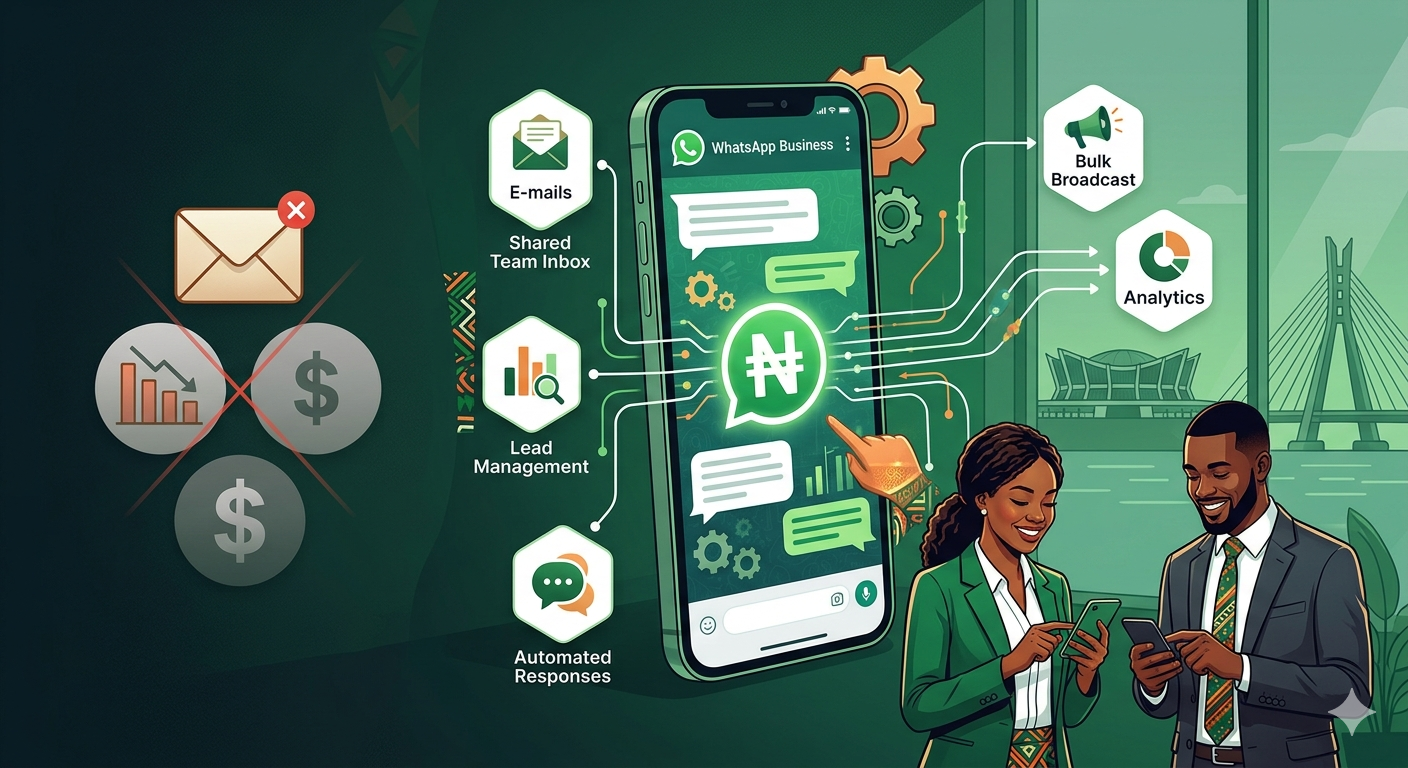
Siteti implements this architecture through its shared team inbox, where every WhatsApp conversation with a customer is visible, searchable, and attributable to specific team members. No sales agent needs to remember to “log” a call or message; the platform records it automatically as part of the conversation flow.
The Shared Inbox As The Sales Floor
In a traditional office environment, a sales manager can walk the floor and observe what every agent is working on. Which customers are being called? Which follow-ups are pending? Which agents are struggling with response volume?
When a business runs its sales operation on WhatsApp using personal phones, that visibility disappears entirely. Conversations are scattered across individual devices. A sales manager cannot see whether an agent has responded to a customer who messaged three hours ago. The sales floor becomes invisible.
A WhatsApp-first CRM restores this visibility through a shared inbox. All incoming and outgoing WhatsApp messages from the entire team are visible in a single dashboard. Managers can see:
- Which agents are currently active
- How many conversations each agent is handling
- Response times for every customer interaction
- Which conversations have been pending for more than a specified duration
Siteti’s shared inbox, available on the Pro plan, provides this visibility for unlimited users. A sales director in Lagos can monitor the performance of agents in Abuja, Port Harcourt, and Enugu from a single interface, something impossible when each agent uses a personal WhatsApp account.
Automation That Matches How Nigerian Customers Actually Behave
HubSpot’s automation capabilities are built around email behavior: opens, clicks, form submissions, and time-based triggers. These assume a customer who engages with automated messages in a predictable sequence.
Nigerian customers behave differently. They send voice notes at 10 pm and expect responses by morning. They ask price questions repeatedly across multiple conversations. They make purchase decisions based on direct interaction rather than automated nurturing sequences.
A WhatsApp-first CRM provides automation designed for this reality. Siteti’s chatbot builder and interactive flows, available on the Growth plan, enable businesses to automate routine responses without forcing customers into unnatural interaction patterns. A customer who asks “what’s the price of item X?” at 10 pm can receive an automated response with pricing and availability, then seamlessly transfer to a human agent for purchase completion.
The distinction is subtle but critical. Email automation seeks to move customers through a funnel without human intervention. WhatsApp automation seeks to augment human conversation, not replace it.
Broadcast Messaging Without The Compliance Headaches
One of the most frequently requested features from Nigerian businesses is the ability to send broadcast messages to large WhatsApp audiences. However, Meta’s policies strictly limit unsolicited bulk messaging, and violations can result in permanent number bans.
A legitimate WhatsApp-first CRM navigates this complexity through official API access. Siteti’s Starter and Growth plans include bulk broadcast capabilities that operate within Meta’s compliance framework. Businesses can send scheduled broadcasts, track delivery and read receipts, and analyze message performance, all through the official WhatsApp Business API rather than unauthorized automation tools that risk account suspension.
The distinction between unauthorized WhatsApp automation and API-based broadcast is not technical pedantry. Unauthorized tools frequently result in permanent phone number bans, destroying years of customer relationships. Official API access, as provided by Meta Business Partners like Siteti, ensures compliance and long-term account safety.
Naira Billing As Infrastructure, Not A Feature
The currency in which a CRM bills is not a minor operational detail. It is a fundamental infrastructure decision that affects financial planning, accounting complexity, and exposure to external risk.
Dollar billing, as practiced by HubSpot and most international CRMs, introduces exchange rate uncertainty into a business’s monthly operating expenses. A Nigerian business cannot accurately forecast its software costs three months in advance because it cannot predict the Naira-dollar exchange rate.
Naira billing, as practiced by Siteti, eliminates this uncertainty. The business pays the same amount every month in the currency it earns from customers. Accounting is straightforward. No virtual dollar cards are required. No international transaction fees apply.
For a Nigerian SME operating on thin margins, this predictability is not a convenience; it is a prerequisite for rational financial planning
HubSpot vs WhatsApp-First CRMs For Nigerian Businesses
A direct comparison between HubSpot and a WhatsApp-first CRM like Siteti requires honest acknowledgment of each platform’s strengths and limitations. This section evaluates both across four critical dimensions: cost, feature relevance, implementation reality, and support quality. The comparison is structured around the operational needs of a typical Nigerian SME with a five-person sales team.
Cost Comparison
The most straightforward comparison is also the most stark.
| Cost Component | HubSpot Professional | Siteti Pro |
| Monthly subscription (5 users) | $800 (~₦1.2M at ₦1,500/$) | ₦638,400 |
| WhatsApp middleware required | Yes (+$50–100/month) | No (native API) |
| Implementation cost | ₦500,000–2,000,000 one-time | Minimal (self-serve or assisted setup) |
| Training cost (initial) | High (behavior change required) | Low (platform matches existing workflow) |
| FX exposure | Full (dollar billing) | None (Naira billing) |
| International transaction fees | 2–5% | 0% |
| Approximate annual effective cost | ₦18–25 million | ₦7.66 million |
The annual cost differential of approximately ₦10–17 million is not trivial. For a Nigerian SME, this sum represents one to three additional staff salaries, significant inventory investment, or multiple marketing campaigns.
Feature Relevance Comparison
Feature relevance is more nuanced than raw cost. The question is not which platform has more features; HubSpot wins that contest decisively, but which platform has features relevant to a WhatsApp-first Nigerian business.
| Feature | HubSpot | Siteti | Relevance to Nigerian SME |
| WhatsApp Business API | Via third-party middleware | Native (official Meta partner) | Critical: primary sales channel |
| Shared team inbox | No | Yes (All plans) | Critical: team visibility |
| Bulk broadcast messaging | No (email only) | Yes (All plans) | High: marketing and announcements |
| Broadcast analytics | N/A | Yes (Growth and up) | High: campaign measurement |
| Chatbot builder | No | Yes (All plans) | Medium: after-hours automation |
| Interactive flows | No | Yes (Growth and up) | Medium: guided customer journeys |
| Email marketing sequences | Yes (core feature) | No | Low: for most Nigerian SMEs |
| Contact scoring | Yes | No | Low: requires email engagement data |
| Website analytics integration | Yes | No | Low: discovery rarely via website |
| Sales pipeline management | Yes (Professional+) | No | Medium: useful but not WhatsApp-native |
| Call recording | No | Yes (Growth and up) | Medium: quality assurance |
| Webhook support | Yes | Yes (Growth and up) | Low: developer-dependent |
The pattern is clear. HubSpot excels at email-centric, website-centric capabilities that assume a customer journey beginning with digital advertising and ending with a form submission. Siteti excels at conversation-centric capabilities that assume a customer journey beginning with a WhatsApp message and ending with a payment confirmation shared via chat.
For a Nigerian SME whose customers discover products on Instagram, inquire via WhatsApp, and pay via bank transfer, the Siteti feature set aligns with reality. HubSpot’s feature set aligns with a different reality entirely.
Implementation Reality Comparison
The difference between purchasing software and successfully using software is implementation. This is where many HubSpot subscriptions fail.
| Dimension | HubSpot | Siteti |
| Time to first message | Days to weeks (requires setup, middleware configuration) | Minutes (connect WhatsApp number, invite team) |
| Team adoption barrier | High (must learn new workflow, log conversations manually) | Low (continues using WhatsApp, now with visibility) |
| Data migration complexity | High (spreadsheet mapping, field configuration) | Minimal (contacts already in WhatsApp) |
| Ongoing maintenance | Significant (workflow updates, integration monitoring) | Minimal (platform handles API compliance) |
| User behavior change required | Fundamental (log everything) | Incremental (use shared inbox instead of personal phone) |
The difference is structural. Siteti does not ask sales agents to change how they communicate. It asks them to communicate in a shared environment rather than a private one. HubSpot asks agents to communicate in one place (WhatsApp) and log that communication in another place (the CRM dashboard). The latter imposes a constant tax on agent attention that most teams eventually refuse to pay.
Support Quality Comparison
For a Nigerian business operating in Nigerian time zones, support quality is not a luxury; it is an operational necessity.
| Support Dimension | HubSpot | Siteti |
| Available hours | 24/5 (weekends limited) | 24/7 |
| Primary channel | Email ticket, chatbot | WhatsApp, phone |
| Local presence | No Nigeria office | Lagos-based team |
| Response time (standard) | 4–24 hours | Minutes to hours |
| Language | English (global) | English |
The practical implication is straightforward. When a Nigerian business encounters a CRM issue at 3 pm on a Tuesday, Siteti responds within minutes via WhatsApp, the same channel the business uses for customers. HubSpot responds within hours via email ticket. For a sales team that cannot afford downtime, this difference is decisive.
The Decision Framework
For a Nigerian business, the choice between HubSpot and a WhatsApp-first CRM should be guided by three questions:
First, what percentage of customer conversations happen on WhatsApp versus email? If the answer exceeds 70 percent, WhatsApp, HubSpot’s email-centric architecture, is working against reality.
Second, does the business have dedicated CRM administration resources? HubSpot requires ongoing maintenance. Siteti largely does not.
Third, is the business serving international or enterprise clients who expect email communication? If yes, HubSpot’s capabilities may be justified despite the cost.
For the majority of Nigerian SMEs, the answers point decisively toward a WhatsApp-first, Naira-billed solution. Siteti represents the most developed implementation of this category currently available in the Nigerian market.
The Rise of WhatsApp-First CRMs: What The Category Looks Like in 2026
The emergence of WhatsApp-first CRMs as a distinct software category was driven by three converging forces: the failure of traditional CRMs to address the Nigerian market, the evolution of WhatsApp from a consumer messaging app to a commercial platform, and the increasing sophistication of Nigerian software builders who refused to accept that “global” software meant software designed for Western markets.
This section traces the emergence of the category, its current state in 2026, and the regulatory and technical developments that are reshaping its future.
How The Category Emerged
Until approximately 2022, Nigerian businesses had essentially three options for managing customer relationships.
The first option was manual operation: sales agents using personal WhatsApp accounts, with customer data stored nowhere except individual phone memories. This was free but completely unscalable, with no visibility for management and no continuity when agents left.
The second option was adapting global CRMs: HubSpot, Salesforce, Zoho, or Pipedrive, retrofitted with third-party WhatsApp middleware. This was expensive, technically complex, and required constant behavioral enforcement to maintain data hygiene.
The third option was building in-house solutions: Nigerian businesses with technical teams developing custom WhatsApp management tools. This was resource-intensive and rarely sustainable beyond the immediate use case.
The gap between these options was the opportunity. WhatsApp-first CRMs emerged to fill that gap: purpose-built platforms that offered the visibility and automation of traditional CRMs without forcing Nigerian businesses into email-centric workflows or dollar-denominated pricing.
Siteti represents the maturation of this category. As an official Meta Business Partner, it operates at the API level rather than through browser extensions or unauthorized automation tools, a distinction that separates legitimate platforms from the grey-market WhatsApp tools that risk permanent account bans.
The Shift From Workarounds To Purpose-Built Solutions
The evolution of the category can be understood through three phases.
Phase one: Workarounds (2018–2021): Nigerian businesses used the WhatsApp Business App manually, with multiple agents sharing a single account by passing a phone between desks. Broadcasts required copying and pasting messages to hundreds of contacts individually. There was no analytics, no team visibility, and no automation.
Phase two: Unauthorized automation (2021–2024): Third-party browser extensions and unofficial API wrappers enabled bulk messaging and basic automation. These tools worked until Meta detected them, at which point business phone numbers were permanently banned. Many Nigerian businesses lost years of customer relationships overnight.
Phase three: Official API platforms (2024–present): Meta opened the WhatsApp Business API to authorized partners like Siteti. Nigerian businesses could finally access bulk messaging, shared inboxes, and automation through official channels with compliance guarantees. The trade-off was cost; API access is not free, but the alternative was constant risk of account loss.
As of 2026, the category has matured to the point where legitimate WhatsApp-first CRMs offer feature parity with global CRMs for conversation-centric use cases while exceeding them on WhatsApp-native capabilities.
Why 2026 Is A Pivotal Year
Three developments in 2026 are reshaping the WhatsApp CRM category and raising the technical bar for what a credible platform must support.
Meta’s BSUID Compliance Deadline
The Business Solution Unique Identifier (BSUID) compliance deadline, effective June 2026, requires all businesses using WhatsApp Business API to implement stricter identity verification and message tracking. The practical implication for Nigerian SMEs is that grey-market automation tools, which never complied with Meta’s terms, will become completely non-functional. Businesses still using unauthorized solutions will face immediate service interruption.
For platforms like Siteti that have maintained official API status and compliance throughout, the deadline is not a disruption but a competitive accelerant. The category will consolidate around Meta-approved partners, and businesses still operating outside the official ecosystem will be forced to migrate.
WhatsApp Username Rollout
Meta’s introduction of WhatsApp usernames, allowing users to be found by @username rather than phone number, changes the customer acquisition dynamic. Businesses can now publish a single, permanent username across all marketing channels, independent of phone number changes or SIM card issues.
This seemingly small change has significant CRM implications. Customer identification shifts from phone numbers (which can change) to usernames (which are persistent). WhatsApp-first CRMs must adapt their contact matching logic accordingly. Siteti has already implemented username-based contact resolution in its shared inbox. Find out how to claim your WhatsApp Business Username here
The Raising Of The Technical Bar
As the category matures, basic features that were once differentiators have become table stakes. A credible WhatsApp-first CRM in 2026 must now include the following:
- Official WhatsApp Business API integration (non-negotiable)
- Shared team inbox with role-based permissions
- Broadcast messaging with delivery and read analytics
- Chatbot builder for after-hours automation
- Naira billing with local payment processing
- 24/7 local support via WhatsApp and phone
The next frontier, already visible in Siteti’s Pro plan, includes voice note transcription, interactive flows, webhook support for custom integrations, and call recording. Platforms that cannot deliver these capabilities will be relegated to the entry-level segment of the market.
Where The Category Is Headed
Three trajectories will define the WhatsApp-first CRM category over the next 24 months.
Payment integration: The natural next step is embedding payment acceptance directly within WhatsApp conversations. A customer who receives a broadcast about a new product should be able to complete the purchase without leaving the chat thread. Siteti’s existing integration with Paystack and Flutterwave positions it well for this evolution.
Voice note as first-class data: Nigerian customers send voice notes prolifically. Most CRMs treat them as files to be stored, not as data to be analyzed. The next generation of WhatsApp-first CRMs will transcribe voice notes automatically, make them searchable, and extract intent signals for sales prioritization.
Deeper local fintech connections: As Nigerian fintechs expand their service offerings, WhatsApp-first CRMs will integrate with bank statement analysis, credit scoring, and automated reconciliation, turning the CRM from a conversation manager into a complete operating system for Nigerian SMEs.
The Strategic Implication For Nigerian Businesses
The emergence of WhatsApp-first CRMs as a legitimate category means Nigerian businesses no longer face a binary choice between manual chaos and expensive, ill-fitting global software. A third option exists: purpose-built, Naira-billed, WhatsApp-native platforms that align with how Nigerian customers actually communicate.
For businesses still using unauthorized automation tools, the BSUID deadline creates urgency. For businesses paying for HubSpot while running sales on WhatsApp, the cost differential creates a compelling case for evaluation. For businesses still operating manually, the barrier to entry has never been lower.
Siteti, as an official Meta Business Partner with transparent Naira pricing and Lagos-based support, represents the current state of the art in this category. Whether it remains the reference implementation will depend on how well it executes against the payment integration and voice note processing frontiers. But the category itself, WhatsApp-first, Naira-billed, built for Nigerian businesses, is no longer emerging. It has arrived.
How to Evaluate Whether To Switch From HubSpot To A WhatsApp-First CRM
The decision to migrate from one CRM platform to another carries inherent risk. Implementation disruption, data migration complexity, and team adoption uncertainty are real concerns. However, for many Nigerian businesses, the cost of remaining on an ill-fitting platform exceeds the risk of switching. This section provides a structured evaluation framework to guide that decision.
The framework consists of five diagnostic questions, each targeting a specific dimension of CRM fit. Following the questions, a simple scoring system helps translate answers into a clear action recommendation.
Question One: What Percentage of Your Customer Conversations Happen on WhatsApp Versus Email?
This is the most fundamental diagnostic question. The answer determines whether HubSpot’s core architectural assumption aligns with your operational reality.
To answer accurately, examine the last thirty days of customer communication. Not what you think happens. What actually happened?
Review:
- New customer enquiries: how many arrived via WhatsApp message versus email?
- Ongoing customer support: how many interactions occurred on WhatsApp versus email?
- Payment confirmations: how many were shared as WhatsApp screenshots versus email receipts?
- Post-purchase follow-up: how many responses came through WhatsApp versus email?
A practical method: ask your sales team to estimate their daily message volume on each channel. Then, audit a sample of ten customer threads to validate.
Threshold interpretation:
- Above 70 percent WhatsApp: HubSpot’s email-centric architecture is actively working against your operations.
- Between 40 and 70 percent WhatsApp: a hybrid approach may be appropriate; further analysis needed.
- Below 40 percent WhatsApp: HubSpot may be appropriate for your use case.
For the majority of Nigerian SMEs selling to domestic customers, the answer consistently exceeds 70 percent WhatsApp.
Question Two: How Many of Your HubSpot Features Does Your Team Actually Use Consistently Every Month?
HubSpot’s pricing bundles dozens of features. Most Nigerian businesses pay for capabilities they never access.
Run a simple audit. Open your HubSpot dashboard and review the last thirty days of usage data:
| Feature Category | Usage Check |
| Email sequences created or active | _____ |
| Contact scoring rules that triggered | _____ |
| Website analytics reviewed | _____ |
| Meeting scheduling links used | _____ |
| Deal pipeline updated (by actual sales activity, not manual cleanup) | _____ |
| Reports generated and used for decisions | _____ |
| Forms submitted through website | _____ |
| Marketing emails sent | _____ |
Count how many of these features show meaningful usage — defined as at least ten actions per user per month.
Threshold interpretation:
- Using three or fewer features consistently: you are paying for a suite but using a fraction. A simpler, cheaper tool would serve the same purpose.
- Using four to six features consistently: HubSpot may be providing genuine value; evaluate whether those features exist in WhatsApp-first alternatives.
- Using seven or more features consistently: HubSpot is likely appropriate for your operations.
The most common finding among Nigerian SMEs is the usage of one or two features, typically contact storage and occasional pipeline viewing, while paying for the full Professional tier.
Question Three: What Is the Naira Cost of Your Current CRM Plan, Including All Integrations, and What Is That as a Percentage of Your Monthly Revenue?
This question moves beyond absolute cost to proportional cost. A ₦1.2 million monthly CRM expense is too high for a business earning ₦5 million monthly (24 percent of revenue) but reasonable for a business earning ₦50 million monthly (2.4 percent of revenue).
Calculate your complete monthly CRM cost, including:
- HubSpot subscription at actual Naira cost (check last month’s bank debit)
- Third-party WhatsApp middleware subscriptions
- Implementation costs amortized over 12 months
- Internal staff time spent on CRM administration (estimate hourly cost × hours)
- Training and ongoing reinforcement time
Then divide by monthly revenue.
Threshold interpretation:
- Above 10 percent of revenue: CRM cost is dangerously high and likely unsustainable.
- Between 5 and 10 percent of revenue: CRM cost is significant; switching would materially improve margins.
- Below 5 percent of revenue: CRM cost is manageable; switching may not be a financial priority.
For context, Siteti’s Pro plan at ₦638,400 monthly represents approximately 1.3 percent of revenue for a business earning ₦50 million monthly — well within the manageable range.
Question Four: Is Your Team Consistently Logging WhatsApp Interactions Into Your CRM, or Is Customer Data Living on Personal Phones?
This question addresses the gap between intended and actual CRM usage. Many Nigerian businesses have HubSpot subscriptions and HubSpot dashboards — but the dashboards contain incomplete data because sales teams do not log their WhatsApp conversations.
To assess honestly:
- Ask three sales agents to open their personal WhatsApp and count how many customer conversations from the last week are reflected in HubSpot.
- Compare the response time recorded in HubSpot to the actual response time on WhatsApp.
- Check whether the deal stages in HubSpot match the actual customer status.
If the data in HubSpot does not accurately reflect customer reality, you do not have a CRM. You have a spreadsheet with a subscription fee.
Threshold interpretation:
- Less than 50 percent of WhatsApp interactions logged: your CRM is decorative, not operational.
- Between 50 and 80 percent logged: partial adoption; training may bridge the gap, but requires ongoing enforcement.
- Above 80 percent logged: the team has adopted the workflow; switching risk is higher because behavior change would be required.
The most common finding is that WhatsApp interaction logging in HubSpot falls below 30 percent, meaning 70 percent of customer data exists only on personal phones, is invisible to management, and is unrecoverable if an agent leaves.
Question Five: Is Your Current CRM Provider Ready for Meta’s June 2026 BSUID Compliance Deadline?
This question addresses future risk rather than current fit. Meta’s BSUID compliance deadline in June 2026 will affect any business using WhatsApp Business API through unauthorized or non-compliant channels.
Ask your WhatsApp middleware provider directly: “Are you an official Meta Business Partner? Will your API connection remain operational after June 2026?”
If the answer is uncertain or the provider is not an official partner, your WhatsApp operations face interruption risk within months.
Threshold interpretation:
- Using unauthorized middleware with no official Meta status: immediate switch recommended to avoid service interruption.
- Using an official partner but paying separately for middleware: evaluate whether consolidating into a single platform like Siteti reduces cost and complexity.
- Not using any WhatsApp integration (manual operations only): no immediate compliance risk, but missing automation opportunities.
Siteti’s status as an official Meta Business Partner eliminates this compliance concern entirely.
A Simple Scoring Framework
Translate your answers into a numerical score for a clear decision recommendation.
| Question | Answer A (0 points) | Answer B (1 point) | Answer C (2 points) |
| Q1: WhatsApp percentage | Below 40% | 40–70% | Above 70% |
| Q2: Features used consistently | 7+ | 4–6 | 3 or fewer |
| Q3: CRM cost as % of revenue | Below 5% | 5–10% | Above 10% |
| Q4: WhatsApp logging rate | Above 80% | 50–80% | Below 50% |
| Q5: BSUID compliance risk | Official partner | No integration | Unauthorized tool |
Score interpretation:
- 0–2 points: HubSpot is likely appropriate for your business. Switching is not recommended at this time.
- 3–5 points: Mixed fit. Evaluate specific WhatsApp-first alternatives for your highest-pain areas. Consider piloting Siteti for a single team or location before full migration.
- 6–10 points: Strong case for switching. Your business is paying for capabilities it does not use, missing capabilities it needs, or facing compliance risk. Migration to a WhatsApp-first, Naira-billed CRM like Siteti is recommended.
The Migration Path
For businesses scoring in the switch-recommended range, migration from HubSpot to Siteti follows a straightforward path:
- Export contact data from HubSpot (CSV format, available in standard HubSpot export)
- Import contacts into Siteti’s shared inbox environment
- Configure team member accounts and permissions
- Run parallel operations for one week to validate data completeness
- Discontinue HubSpot subscription
The migration typically takes two to three days for a five-person sales team. The operational disruption is minimal because the fundamental sales workflow, WhatsApp messaging, remains unchanged. Only the visibility and management layer changes.
For businesses concerned about historical data loss, Siteti’s support team provides migration assistance to ensure no customer context is abandoned during the transition.
Frequently Asked Questions
Can a WhatsApp-first CRM replace HubSpot entirely? For most Nigerian SMEs operating in the domestic market, yes. The exception is businesses with significant international or enterprise clients who expect email as their primary communication channel.
What happens to my HubSpot data if I switch? HubSpot allows full CSV export of contacts, companies, and deals. This data imports directly into Siteti. Existing WhatsApp conversation history remains accessible within WhatsApp itself.
Do WhatsApp-first CRMs support pipeline management? Siteti prioritizes conversation management over visual pipelines. For businesses with sales cycles measured in hours rather than weeks, the conversation record itself provides sufficient context. Businesses needing both can use Siteti alongside a lightweight deal tracker.
Is this only for B2C businesses? No. The relevant distinction is communication channel preference, not B2B versus B2C. Many Nigerian B2B relationships — logistics, wholesale, and professional services- now operate primarily on WhatsApp.
What about customers who use email? Maintain Siteti for WhatsApp operations alongside a lower-cost email tool like Mailchimp’s free tier or HubSpot’s free CRM. This hybrid approach remains substantially cheaper than HubSpot Professional alone.
Is my WhatsApp Business number safe? Yes, when using an official Meta Business Partner like Siteti. Unauthorized automation tools risk permanent number bans. The June 2026 BSUID compliance deadline will make unauthorized tools non-functional.
Does Siteti offer a free trial? No. The Starter plan at ₦46,400 monthly provides access to bulk broadcasts and quick replies, sufficient for validation before committing to larger plans.
What if Meta changes API pricing? Meta’s per-conversation fees are passed through at cost with no markup. Siteti’s platform fee remains fixed. This transparency compares favourably to HubSpot’s middleware providers, which often bundle or mark up these costs.
Conclusion
Return to the scene that opened this essay: the sales manager paying over ₦1.2 million monthly for HubSpot Professional while his sales team communicates exclusively on WhatsApp and rarely opens the CRM dashboard.
After switching to Siteti Pro at ₦638,400 monthly, the financial improvement is immediate, a 47 percent reduction before accounting for eliminated middleware and FX costs. The annual savings exceed ₦7 million.
But the operational improvements matter more. The shared inbox provides visibility that manual WhatsApp operations cannot. Broadcast analytics reveal which messages actually convert. The chatbot captures leads after hours. And the sales team uses the system because it works the way they already work, inside WhatsApp.
The broader point. The best CRM for a Nigerian business is not the one with the most features or the strongest global brand. It is the one that matches how Nigerian customers communicate, how Nigerian teams operate, and how Nigerian businesses manage their finances.
HubSpot is excellent software for markets where customers reliably use email, budgets are denominated in dollars, and sales cycles span weeks. These conditions describe a subset of Nigerian businesses. They do not describe the typical Nigerian SME operating in the domestic market with local customers and Naira budgets.
For that typical SME, WhatsApp-first, Naira-billed platforms like Siteti are not a compromise. They are the correct solution for the actual operating environment.
A final recommendation. Before renewing your next HubSpot subscription, run the five-question audit from Section Nine. If the answers point toward switching, as they will for the majority of Nigerian SMEs, the path is clear. Export your contacts. Configure Siteti. Run parallel operations for one week. Then cancel HubSpot and redirect the savings toward the people and inventory that actually serve your customers. The software should serve the business, not the other way around.