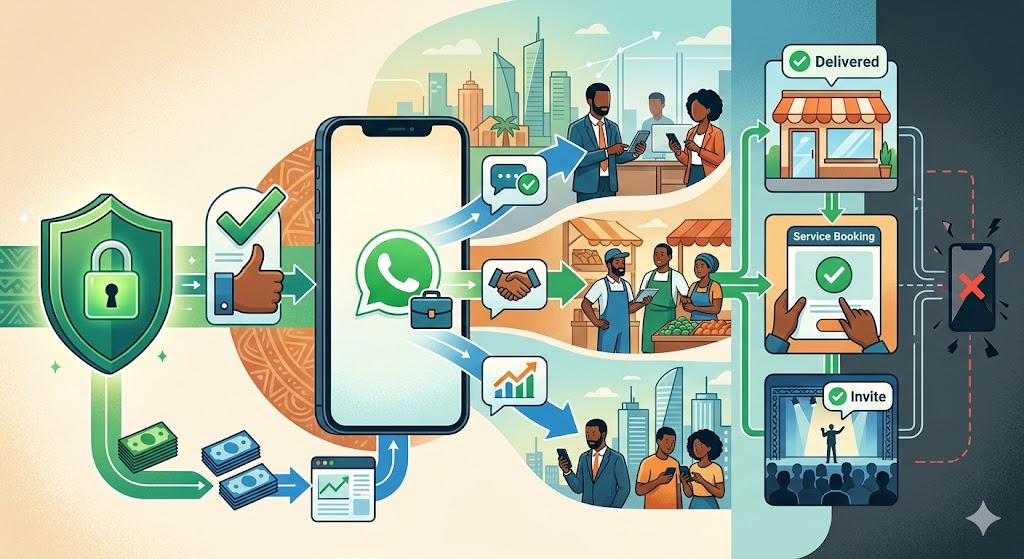
By 2026, WhatsApp had transformed vastly from its original purpose as a medium of private chat. It has silently replaced the primary channel of communication between businesses and their customers in countries like Nigeria, Kenya, South Africa, India, Brazil, and Indonesia. For many small and medium-scale businesses, WhatsApp is turning into a major hub for a gamut of activities related to sales, customer service, client acquisition, marketing campaigns, and post-sale engagement rather than an additional channel for communication.
This comprehensive manual will cover everything from the basics of WhatsApp marketing to in-depth analyses of how it works in the current environment. It will cover the technological foundation of WhatsApp, strategic advantages that make it even more effective, challenges that business owners often overlook, the growing importance of automation, and the game-changing effect of the WhatsApp Business Platform on business messaging.
This 2026 edition has everything you need to make WhatsApp work for big company growth. It explains what bulk WhatsApp messaging is, how to follow Meta’s rules, and how to select the best solutions for your business.
What Is WhatsApp Marketing?
WhatsApp Marketing essentially means using WhatsApp strategically and at a larger scale to connect with customers for different goals: generating leads, nurturing relationships, sending promotions, customer support, and operational communications. In the old days, there was mainly the free WhatsApp Business App, but modern WhatsApp marketing relies on the WhatsApp Business API. This API enables automation, running large-scale campaigns, pipeline management, and the ability to coordinate operations among many agents.
The core change is moving from traditional reactive WhatsApp, where companies wait for customers to contact them, into proactive WhatsApp marketing. This way, businesses can create systematic communication flows that include welcome messages, regular campaigns, and reminders about abandoned purchases, follow-up messages, appointment notifications, logistics notifications, and promotional activities at the right time. What sets WhatsApp marketing apart is the evolution it has undergone from merely broadcasting simple messages to establishing engaging dialogues and, therefore, an engaging platform, yielding tangible sales results.
Why WhatsApp Marketing Works in 2026
Success at WhatsApp marketing in 2026 is not an accident but rather the result of five converging factors: the continued rise of the mobile device, the decline in the effectiveness of email marketing, customers demanding quick reaction times, further investment by Meta in the capabilities of Business API, and the upsurge in the popularity of conversational commerce. Authentic conversations prove more effective than traditional ads. A consumer who chats with a company is far more likely to purchase than one who has not. WhatsApp is many mobile users’ primary communication channel in developing countries, and resistance is low.
This way, customers need not download new apps, learn new skills, or overcome login hurdles; all they do is engage. WhatsApp is emerging as a potent marketing tool, not just for customer support. Brands now use it to close leads and answer queries, promote deals, manage loyalty programs, gather feedback, announce new products, and maintain relationships with their customers. Here, the strategy is all about matching their marketing tactics with natural communication habits.
Types of WhatsApp Marketing: Broadcasts, Automation, Bots & API
While WhatsApp as a marketing channel feels rather simple, it actually has many layers. The most sophisticated marketers of 2026 leverage a mix of broadcasting, automation, workflows with bots, and API-level integrations to drive seamless customer experiences.
Broadcast messaging forms the backbone of brand communication. Using Meta-approved templates, businesses can send targeted promotional messages, product updates, seasonal campaigns, and retention-driven nudges to opted-in customers. Unlike spammy “bulk messaging services” from the past, modern WhatsApp broadcasting is regulated, high-quality, and tied to real CRM data.
Automation is the next layer. A WhatsApp CRM automatically greets new leads, qualifies, routes them to the right agent, delivers brochures, sends reminders, and follows up on its own. This level of operational consistency is impossible with mere manual messaging. Check out this guide on how to Automate Follow-Ups with WhatsApp CRM.
Bots bring conversational intelligence into play. They answer routine questions, capture customer data, and walk leads through some structured decision flows. Say, in real estate, a bot can send over listings of available properties, schedule an inspection, and pass on a warm lead to a human agent-all inside WhatsApp.
WhatsApp Business API is the infrastructure that backs this ecosystem, allowing multi-agent access, bulk sending of campaigns, CRM integrations, templating of messages, analytics, and advanced workflows. No serious business can scale WhatsApp marketing without it.
WhatsApp Bulk Messaging Explained
Previously, “WhatsApp bulk messaging” could refer to unofficial tools, cracked software, or grey-market services that would illegally broadcast thousands of messages. Meta has aggressively shut those down. In 2025, the only legal way to bulk message on WhatsApp is through Meta-approved API providers, and every message template must be pre-approved by Meta.
When done correctly, bulk messaging is not spam; it’s targeted, permission-based, and linked to customer intent.
With any of the modern WhatsApp bulk messaging services, businesses can send:
- promotional campaigns
- Restock alerts
- appointment reminders
- Property inspection invites
- Updates on delivery and logistics
- onboarding sequences
- lead revival campaigns
All of these have to follow strict opt-in rules, but if done right, bulk messaging actually becomes the highest converting channel for customer outreach. Importantly, API-driven bulk messaging integrates directly with CRM workflows: this means that campaigns can segment customers by status, behaviour, or time instead of sending generic blasts.
WhatsApp Marketing Compliance & Meta Policies
Understanding Meta’s compliance standards is crucial for a successful WhatsApp marketing strategy. As of 2025, regulations on preventing spam on WhatsApp have become stricter rather than lenient. Businesses are required by Meta to obtain clear consent from users, engage in meaningful conversations, and send messages that provide value.
Meta ensures compliance by;
- Template approvals
- Message quality ratings
- Conversation categories
- Sender reputation scores
- Rate limits for low-quality senders
Businesses that engage in unauthorized practices like using unapproved senders, unauthorized contact lists, or spam-like mass messaging risk having their accounts suspended. On the other hand, businesses that adhere to the rules benefit from increased messaging limits, lower costs per conversation, and better delivery rates. Compliance should be seen as the foundation of a sustainable WhatsApp marketing strategy, not as a barrier.
Best WhatsApp Marketing Tools vs WhatsApp Business vs API
The main nuances to consider when selecting a WhatsApp marketing solution are the differences between the free WhatsApp Business app and external tools and the WhatsApp Business API. The no-cost WhatsApp Business app is ideal for small businesses instead of a big operational team since it works only on one device, with broadcast size limitations and basic automation features.
This year, it is suggested to refrain from using third-party marketing tools for WhatsApp that operate on unauthorized platforms. While free messages, unlimited bulk messaging, or avoiding Meta’s limitations might sound enticing, such software could compromise the security of your contact information.
For the reasons of better security, scalability, multi-agent support, automation, and compliance, the WhatsApp Business API is a better choice. Siteti, among other platforms offer businesses an all-in-one marketing and CRM suite directly integrated with the API and enables smooth workflows, broadcast campaigns, automated follow-ups, agent dashboards, and analytics-all in one place.
In any business that desires significant growth this year, leveraging API-level functionalities is key. Anything less than that could get in the way of progress.
How to Choose the Right WhatsApp Marketing Tool
The choice of tool depends on variables such as the size, purpose, and growth plans of your organization. From the year 2025 onwards, key factors for consideration will include adaptability, depth of automation, outreach capacity, compliance with regulations, multi-agent functionality, integration with CRM systems, and the availability of API templates.
The basic question to be answered is whether you want to build relationships or drive growth. If you only want to handle customer conversations manually, then the WhatsApp Business App is enough for that purpose.
However, if the ambitions include automating sales, running campaigns, managing teams, integrating CRM processes, and using WhatsApp for marketing growth, a platform like Siteti, API-based, becomes a must. The choice of your tool will outline the entire strategy of your WhatsApp marketing.
Siteti Users Using WhatsApp Marketing
Practical illustrations abound of how WhatsApp marketing operates effectively on a large scale in real life:
Yefepere is a fast-growing gift company that uses Siteti to automate the confirmation of orders, manage fulfillment across various locations, and send notifications of delivery. Automation replaced manual handling of messages, thus speeding up order processing and reducing the number of missed orders.
Triconna Real Estate uses WhatsApp broadcasting for notifications on upcoming property viewings, availability of properties, and updates on payment schemes. Integrating automated follow-ups has indeed increased the conversion rate from an initial inquiry to the inspection stage.
Similarly, Swisszaco Real Estate leverages WhatsApp CRM sequences to manage a great volume of leads that are generated through Facebook ads. Automated lead qualification, scheduling appointments, and sending reminders for property inspections have all helped the company sustain high levels of sales efficiency despite a rapid influx of leads. Such examples in themselves highlight the fact that WhatsApp serves not merely as a medium of marketing but also as a pivotal driver of revenue.
Try Siteti WhatsApp Marketing Platform
Set up a solid foundation if you want to make WhatsApp your strongest marketing channel in 2025.
Siteti gives you the full WhatsApp marketing suite: broadcasts, automation, CRM workflows, bots, analytics, and team inbox, all built on top of the official WhatsApp Business API.
Commence your WhatsApp marketing journey with Siteti today and let conversations become conversions.