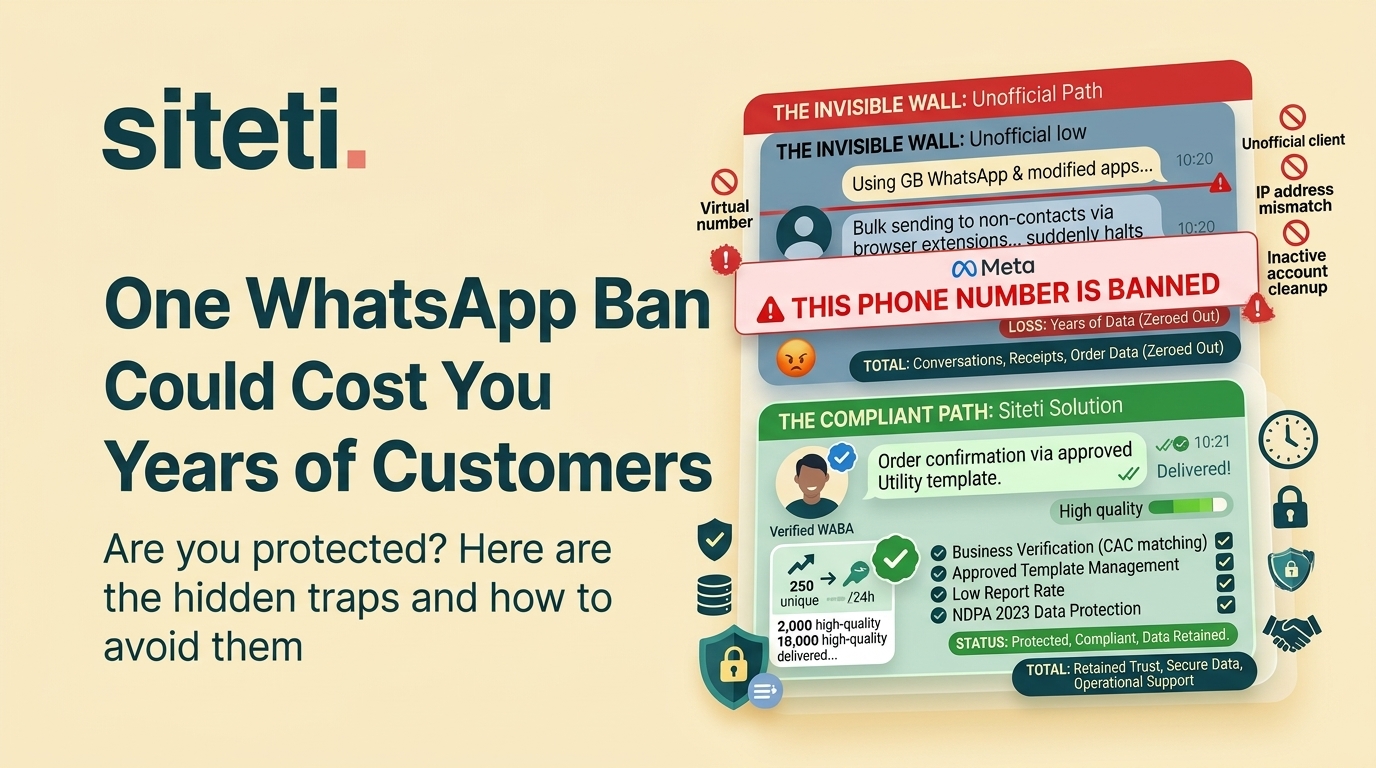
The worst morning for a Nigerian business owner is not a morning without orders. It’s opening your phone and seeing the red banner: “This phone number is banned from using WhatsApp.” Three years of customer conversations, pending transfer receipts, unshipped orders, and the number printed on your packaging and billboards, all zeroed out in a single second. You don’t even know what you did wrong. You just sent a promotion, used “marketing software,” or blasted a few messages on WhatsApp Web. But here is the truth: experiencing a WhatsApp Business ban in Nigeria isn’t random bad luck. It is systematic, predictable, and triggered by specific Meta policy conditions. Most business owners never learn where that wall is until they hit it.
This article is the map to that wall.
Technical Mistakes That Can Get Your WhatsApp Number Banned
Meta doesn’t reason with you. Its systems judge in milliseconds: does this number look like a normal user?
Unofficial clients or modified WhatsApp apps, like GB WhatsApp, WhatsApp Plus, and various browser “automation extensions” (like WAPlus), operate through simulated clicks and DOM manipulation, and Meta’s AI can detect non-human interaction patterns. Once flagged, the result is not a warning but a permanent ban. Many business owners think these tools “just improve efficiency,” but they’re actually playing Russian roulette with their primary number.
Bulk sending and sudden traffic spikes: You send a promotion to 200 contacts on WhatsApp Business. Meta’s anti-spam algorithm doesn’t see “marketing”; it sees “abnormal outbound traffic surge.” Within minutes, the number gets restricted or banned. WhatsApp’s rule isn’t “you can’t send messages”; it’s “you can’t suddenly send messages at non-human speed.”
Reported by multiple users: Even if the other party contacted you first, as long as a few people tap “Report Spam” within the same time window, Meta’s automated system triggers a shadowban or permanent shutdown. In Nigeria, customers have extremely low tolerance for “sales messages”; if just 5 people in a broadcast list are annoyed, your number enters the danger zone.
Virtual numbers or VoIP numbers: WhatsApp doesn’t trust numbers registered on non-physical SIM cards. Registration with virtual numbers carries an extremely high probability of being flagged.
IP address and number location mismatch: A Nigerian number registering or logging in from a German or American IP, this is the most classic “hijacking signal.” Meta’s system flags it immediately. A more subtle trap: multiple WhatsApp accounts registered under the same IP, or accounts frequently jumping between different IPs, are all judged as suspicious behavior.
30 days of inactivity: This is the easiest one to overlook. Meta locks sender numbers with no message traffic for 30 consecutive days. You registered for the official API, configured everything, then forgot to send messages; 30 days later, the number is locked. This isn’t punishment; it’s system cleanup.
Products And Business Activities That Trigger A WhatsApp Business Ban In Nigeria
There’s a key distinction many Nigerian business owners never figure out:
“Business Messaging Policy” governs whether you can send messages. “Commerce Policy” governs whether you can use WhatsApp’s commerce features (catalog, payments) to sell things.
Selling prohibited goods doesn’t mean you can’t use WhatsApp at all. But if your business category falls into high-risk categories, Meta’s enforcement escalates: warnings → 1 or 3 days banning marketing, utility, and authentication template messages → 5, 7, or 30 days banning all messages → account lock → permanent disablement.
Here are the categories Nigerian businesses most easily stumble into:
Financial: Loans, Crypto, Investments — Completely Ineligible for API Access
Meta explicitly classifies “payday loans, paycheck advances, P2P lending, debt collection, and bail bonds” under the MISLEADING violation category. In Meta’s three-tier eligibility system, lending and debt collection fall under the Prohibited tier — meaning they are ineligible to use the WhatsApp Business API under any circumstances.
This means that it is not that the content of your collection message is problematic. It is that your identity as a lender or debt collector is itself not permitted on the WhatsApp Business API. Even if you hold an FCCPC lending license in Nigeria, Meta’s restriction is not exempted by local permission. If your fintech has a lending business line, that business line will also prevent you from using WhatsApp for any related communication.
Meta’s official violation list confirms this. The MISLEADING category explicitly covers: multi-level marketing, ICOs and binary options, payday loans, salary advances, P2P lending, debt collection, and bail bonds. The REAL_FAKE_CURRENCY category explicitly prohibits transactions involving real currency, virtual currency, cryptocurrency, and active bank credit/debit cards.
What this means for Nigerian fintechs: If your core business is lending, P2P lending, debt collection, or cryptocurrency trading, you are not “at risk of getting banned” — you are not on the API eligibility list at all. Understanding these restrictions is critical to preventing an unexpected WhatsApp Business ban in Nigeria, even if you hold a local lending license.
Gambling and Betting: Commerce Prohibited, Advertising Conditionally Allowed
Meta’s GAMBLING category states that businesses may not transact in or facilitate paid gambling, games of skill, or lotteries through WhatsApp, including online casinos, sports betting, bingo, or poker, but Nigeria is not on Meta’s list of unsupported gambling markets. Meta’s published list of unsupported markets includes: Azerbaijan, Bangladesh, Cambodia, Egypt, Hong Kong, India, Indonesia, South Korea, Kyrgyzstan, Malaysia, Mongolia, Myanmar, Pakistan, Philippines, Saudi Arabia, Singapore, Taiwan, Thailand, and Vietnam. Nigeria is not on this list.
This means Nigerian betting companies can:
- ✅ Apply for Meta advertising authorization, submit local regulatory licenses, and run Click-to-WhatsApp ads
- ✅ Use WhatsApp for pure customer service (checking balances, answering account questions) without involving promotions or transactions
- ❌ Cannot use WhatsApp catalog or payment features to accept bets
- ❌ Cannot send templates containing odds, promotions, or betting instructions
- ❌ Cannot facilitate any betting transactions through WhatsApp
In simpler words, loans and debt collection cannot even get through the door; betting can get through the door, but you can only stand at the entrance and talk (customer service/advertising); you cannot go inside and do business (transactions/promotions).
Healthcare: Services Allowed, Products Prohibited
Meta’s official HEALTHCARE category prohibits transactions involving: medical devices (contact lenses, bandages/braces, thermometers, disease testing kits, breast pumps, first aid kits), and nicotine cessation products (nicotine patches, nicotine gum). The DRUGS category prohibits the sale of illegal drugs, prescription drugs, and recreational drugs, but manufacturers and healthcare service providers not engaged in direct sales are allowed.
What this means for Nigerian healthcare businesses: Licensed clinics, hospitals, and telemedicine platforms (like Helium Health, Tremendoc) can use WhatsApp for appointment reminders, test result notifications, and patient follow-up, as long as no direct product sales are involved. Nigerian pharmacies cannot sell prescription drugs, over-the-counter drugs, or medical devices through WhatsApp commerce features.
Digital Products and Subscriptions: An Easily Overlooked Prohibited Category
The DIGITAL_SERVICES_PRODUCTS category explicitly prohibits: sales of digital content, digital subscriptions, digital accounts, downloadable content (PDFs, music, games, videos), and digital coupons, including subscription renewals and upgrades.
This is not about whether your business is legitimate. It is about the product type. Meta classifies digital goods as a restricted category at the Commerce Policy level because they are difficult to verify, have no physical delivery, and are prone to disputes and fraud.
What this means for Nigerian businesses: SaaS platforms, online course sellers, e-book vendors, and streaming subscription resellers cannot use WhatsApp’s catalog or payment features to complete digital product transactions. However, they can use WhatsApp for customer service, marketing messages, and automated notifications, as long as payment and delivery happen outside WhatsApp (your website, bank transfer, etc.). WhatsApp’s official help center confirms that entities engaged in digital subscriptions and services can access WhatsApp for business messaging, but cannot use WhatsApp’s commerce product features (catalog, payments). In other words, the restriction targets the transaction closed loop within WhatsApp, not your right to use WhatsApp for communication.
Other Prohibited Categories At A Glance
Dating Services: Completely Prohibited: The DATING category prohibits businesses from transacting in or facilitating online dating services. This is a clear-cut prohibition — not “conditions apply,” not “requires authorization.” Online dating services are not allowed to be transacted or facilitated on the WhatsApp Business Platform under any circumstances. Meta classifies dating as a high-risk category, typically associated with fraud, harassment, and personal safety risks.
Adult Products and Services: The ADULT category prohibits adult products and services, including sex toys and adult videos. This is a high-risk prohibited category. Unlike some other categories where enforcement escalates from warnings, adult-related violations may trigger immediate restriction or permanent disablement upon detection.
Cryptocurrency and binary options: Sales of “real, virtual, or fake currency” are prohibited, explicitly including cryptocurrency and ICOs. Nigeria is one of Africa’s largest crypto markets, with many projects promoting tokens in WhatsApp groups and private chats; this is a direct Commerce Policy violation.
Multi-level marketing (MLM): Classified as a “misleading business model”. Many “network marketing” and “referral rebate” businesses in Nigeria walk this line.
Alcohol and tobacco: Sales of alcoholic beverages, including alcohol-related items, are prohibited. Nigerian alcohol brands and online liquor stores promoting on WhatsApp are in violation.
Live animals: Sales of live animals are prohibited, but pet supplies, veterinary services, grooming services, and boarding services are allowed.
Mandatory API Compliance Rules To Prevent A WhatsApp Business Ban In Nigeria
No matter what you sell, the following requirements are mandatory. Fail to meet them, and your number is at risk of being shut down at any time.
Business Verification
You need to provide a company name, address, and registration number consistent with your business license. Using false information, names inconsistent with the legal entity, or missing registration documents, these are all explicitly listed restriction triggers.
Common pitfalls for Nigerian businesses: Meta’s verification bot reads “Kola Foods Ltd” and “Kola Foods Limited” as two different entities. Your CAC registration name and your WhatsApp display name must match as closely as possible. Clean submissions typically take 3–7 business days. If your business has no CAC registration, you cannot complete Meta’s business verification, and therefore cannot directly access the WhatsApp Business API.
Template messages Must Be Approved By Meta
You cannot directly send arbitrary text to customers. All business-initiated messages must use approved templates, and the template category (Marketing / Utility / Authentication) must be accurate. Template category errors are themselves an explicit violation item. Marking marketing messages as “Utility” to bypass fees or restrictions is a common mistake and a common ban cause.
Template quality ratings are divided into high quality, medium quality, and low quality. Low-quality templates may be automatically paused, with pause durations escalating from 3 hours to 6 hours to permanent disablement.
User Report Rate And Quality Rating
Meta monitors how many people report or block your messages. Quality ratings are based on customer feedback over the past 7 days and are divided into green (high quality), yellow (medium), and red (low quality). Sustained red status flags your number and downgrades your messaging limits. In Nigeria, high broadcast frequency, irrelevant content, and messages without opt-out options are the main causes of surging report rates.
Data Protection: NDPA 2023 Replaced NDPR
You must not request or share complete payment card numbers, bank account numbers, personal ID numbers, or other sensitive information on WhatsApp. Many Nigerian businesses ask customers to send bank card numbers or transfer receipts in conversations; this is not only a security risk but also a direct trigger for a WhatsApp Business ban in Nigeria.
Key update: NDPA 2023 (Nigeria Data Protection Act) has replaced NDPR 2019 and is now the primary law enforced by the Nigeria Data Protection Commission (NDPC). NDPA introduced the “important data controller” category, requiring organizations processing more than 100 data subjects to appoint a Data Protection Officer, and formalized cross-border data transfer requirements. Any compliance guide that only references NDPR is now outdated.
News businesses require additional registration
If you primarily publish news content, you must register through Facebook’s News Page Index. News aggregation businesses are still prohibited from using business messaging features.
Messaging limits
Newly created business portfolios have a messaging limit of 250 unique users per 24 hours. This limit can be increased to 2,000 by completing the scaling path (business verification, or sending 2,000 high-quality delivered messages), then automatically scaling to 10,000, 100,000, or unlimited based on quality rating and usage. All phone numbers share the same portfolio limit.
You’re Not Being Targeted, You Just Didn’t Know the Rules.
Meta’s enforcement logic isn’t “catch you and kill you.” It’s:
Warning → Short-term restriction (1/3 days) → Medium-term restriction (5/7/30 days) → Account lock → Permanent disablement.
Each step has an appeal window, usually with results in 24-48 hours. But the success rate of appeals depends on whether you truly understand which line triggered the rule, not on writing “I didn’t violate anything” in the appeal box.
For Nigerian businesses, the most dangerous thing isn’t “not knowing the rules.” It’s thinking you’re using official tools when you’re actually using violating tools—like browser extensions, QR code bulk messaging software, and unofficial platforms promising “unlimited sending.” Meta’s detection capabilities have made the ban rate for these tools approach 100%.
Protecting yourself against a WhatsApp Business ban in Nigeria comes down to using verified, official channels. Your number is a core brand asset printed on your packaging and marketing materials. It shouldn’t be a gamble.
What Siteti does is simple: Get you onto the official channel before you hit the wall. We don’t sell “tricks to evade bans”; we only provide compliant WhatsApp Business API access, template management, and operational support that fits Nigerian business realities. Your number should belong only to you.
The Siteti Blog
Siteti is a fast, simple WhatsApp CRM built to turn chats into sales and support at scale.
@2025 Siteti.com. All right Reserved.